
 China Church Solidarity (CCS)
Get involved!
Find out how by contacting us at:
China Church Solidarity
Mobile Ireland:
086 330 3070
Thanks for visiting our new website. Browse it to find out more about us and China.
 Share
ShareCatholic Church Updates
March Updates 2026
3 Updates- Please click the blue address link.
1. The Lenten journey of Chinese Catholic communities: visits to the sick, spiritual retreats, formation courses
February Updates 2026
7 Updates- Please click the blue address link.
1. The parish of Our Lady of Lourdes, of the Missions Étrangères de Paris, celebrates 130 years of its missionary history
2. Catholic communities visit the families of priests and nuns ahead of the Lunar New Year
3. Pushanghui Catholics restore their parish church with their own hands
4. Traditional works of charity and mercy promoted in preparation for the Lunar New Year have already begun
5. Remembering a missionary who ‘changed’ Christian life in China
https://www.ucanews.com/news/remembering-a-missionary-who-changed-christian-life-in-china/111742
6. New bishop takes charge of Chinese Catholic diocese
https://www.ucanews.com/news/
7. Cardinal Tagle celebrates 80th anniversary of Hong Kong diocese
END
January Updates 2026
3 Updates- Please click the blue address link.
1. The closing of the Jubilee Year and the many "new beginnings" of Chinese Catholic communities
2. Hong Kong: Asian Church leaders gather to discern AI’s pastoral impact
3. Catholic Church in China Faces Crisis
https://irishrover.net/2025/
END
December Updates 2025
7 Updates- Please click the blue address link.
1. The Bible Day Celebrations Held among Churches in Xinjiang
4. Bishop of the Apostolic Prefecture of Xinxiang consecrated in China
November Updates 2025
7 Updates- Please click the blue address link.
1. Chinese ‘underground’ bishop dies at 91 after decades of oppression
30th October 2025
2. Celebrations continue for the 420th anniversary of the church founded by Jesuit Matteo Ricci in Beijing
3. World Mission Day for Chinese Catholic communities: "Help the mission with generosity"
4. Bringing living water to Hong Kong through music
5. Auxiliary bishop ordained for Shanghai
https://www.examiner.org.hk/
6. Numerous priestly and religious vocations in Chinese Catholic communities
7. China communities share Mid-Autumn joy through acts of charity
END
October Updates 2025
8 Updates- Please click the blue address link.
1. The three Bishops of Zhangjiakou celebrate the Eucharistic liturgy together in Qujiazhuang: communion in the diocese is "a grace and a gift from God"
2. Doctors from the Shanghai Catholic Intellectuals Association promote initiatives for children with special needs.
3. Chinese government bans Catholic priests from teaching, evangelizing online
7. Cardinal Stephen Chow and Fr. James Martin Discuss the Spiritual Life
9th September 2025
https://www.youtube.com/watch?v=3Y-cm7XEzKo
8. Pope Leo should unveil a bold new approach toward China
2nd October 2025
END
September Updates 2025
8 Updates- Please click the blue address link.
1. Shanghai parish adopts measures to beat the heat
https://www.examiner.org.hk/
2.). Eleven New Pastoral Staff Ordained in Shaanxi CC&TSPM
4. Young people share faith, unity, and hope at Jubilee of Youth in Rome
5. Reflections from the vicar general: Responding to vocations
7. New church in Yiwu named after Saint Joseph: Home to the world's largest wholesale market
21st March 2025
August Updates 2025
6 Updates- Please click the blue address link.
1. Hong Kong youth in Rome for the Jubilee
https://www.asianews.it/news-
https://www.youtube.com/watch?
END
July Updates 2025
4 Updates- Please click the blue address link.
1. The People of God in China accompany the priests in their “Jubilee of Hope”
2. A journey of faith and transformation: Father Cuddigan retires after five decades of service
June Updates 2025
4 Updates- Please click the blue address link.
1.Cardinal Chow: Pope Leo wants to visit China, let us pray that his dream may come true
https://www.indcatholicnews.
END
May Updates 2025
5 Updates- Please click the blue address link.
1. From Refugees to Redevelopment: Cross Hill, Ming Yuen School, and Tiu Keng Leng's Transformation
2. Church in Hong Kong expected to remain bridge between Vatican and Beijing
3. A Christian perspective on the encounter between the Gospel and China
4. More Catholic clergy in China dying due to lifestyle diseases
https://www.ucanews.com/news/
5. “Qingming": Traditional Remembrance of the Dead is an opportunity for Catholics to bear witness
END
April Updates 2025
9 Updates- Please click the blue address link.
1. China’s National Religious Groups Joint Conference: “Preach the Two Sessions”
2. New church in Yiwu, Hangzhou
4. Four new priests ordained in Ningbo on the Feast of the Annunciation
March Updates 2025
2 Updates- Please click the blue address link.
1. Video: Building a Synodal Church — Participation of Chinese bishop’s from the Mainland
February Updates 2025
5 Updates- Please click the blue address link.
1. The Lunar New Year of Chinese Catholic communities: Blessing for families, visits to hospitals, works of charity
END
January Updates 2025
12 Updates- Please click the blue address link.
1. China’s oldest priest dies at 104: a life of faith amid 25 years of persecution
December Updates 2024
6 Updates- Please click the blue address link.
1.Jubilee 2025 webpage of the Diocese of Hong Kong and social media plaforms now live
2nd December 2024
3. Chinese Catholic communities study and spread the Papal Bull “Spes non confundit” in preparation for the Jubilee
4. Advent pastoral letter from the Cardinal
29th November 2024
5. Connecting with Hong Kong Catholic migrants in Great Britain
29th November 2024
END
November Updates 2024
8 Updates- Please click the blue address link.
1.Vatican-approved bishop consecrated in Beijing days after China deal renewal.
3. Beijing Archbishop Li Shan gets a coadjutor, Zhen Xuebin
6. The ecclesial information site Xinde invites Chinese Catholics to pray with the Pope for peace in the world
7. China is removing crosses from churches, replacing images of Christ with Xi Jinping
8. Before leaving for Rome: Bishop Vincent Zhan Silu blesses the foundation stone for the construction of a new church
END
September Updates 2024
4 Updates- Please click the blue address link.
1.China-Zentrum Catholic Colloquium discusses young people in China
August Updates 2024
12 Updates- Please click the blue address link.
1.After years, the Diocese of Shanghai celebrates the patronal feast of St. Ignatius with its Bishop
July Updates 2024
7 Updates- Please click the blue address link.
1.Catholic Charities in relief of flood-affected populations
26th June 2024
2. New church dedicated to Saint Anthony of Padua has been consecrated, and is the result of the commitment of the entire community
19th June 2024
3. Where does the great devotion of Chinese Catholics to the Sacred Heart of Jesus come from?
14th June 2024
4. Belgian delegation led by Cardinal Jozef De Kesel visits mainland China
12th June 2024
5. Priests and nuns of Guizhou study to "adapt" catechism to new pastoral needs
8th June 2024
6. Because of the grain harvest: Bishop Sun Jigeng celebrates the Feast of the Sacred Heart in the village of Chaizhuangcun "in advance"
6th June 2024
END
June Updates 2024
7 Updates- Please click the blue address link.
1.Chinese and Taiwanese Churches to walk ‘hand in hand’
30th May 2024
https://www.ucanews.com/news/
2. In Xiamen Bishops and scholars from Taiwan and mainland China meet to "walk together" in a Seminar dedicated to inculturation
29th May 2024
3. Bishop Shen Bin celebrates the solemn liturgies on the feasts of Mary Help of Christians and the Most Holy Trinity
27th May 2024
7. Diocese of Hong Kong on bridge-building trip to Guangdong
3rd May 2024
END
May Updates 2024
7 Updates- Please click the blue address link.
1.Marian Month at the Shrine of Sheshan: online bookings for pilgrimages.
27th April 2024
2. World Day of Prayer for Priestly Vocations in Catholic Communities: Between hope and crisis
25th April 2024
3. New provincial council for Sisters of St Paul de Chartres
24th April 2024
4. 100th anniversary of the founding of the Catholic parish in Lanniquing: Yi ethnic group pays tribute to the French missionary Paul Vial.
17th April 2024
5. Reflections from the vicar general: Prison evangelisation
12th April 2024
6. Generous participation of Chinese Catholic communities in the 2024 "National Collection" to support relief initiatives in emergency situations.
11th April 2024
7. 470 baptisms in Shanghai, consecration of a new church in Wenling: an Easter full of fruits of faith.
9th April 2024
END
April Updates 2024
5 Updates- Please click the blue address link.
1.Card Chow: Easter and hope in Hong Kong today
30th March 2024
2. Celebrating Easter in Mongolia: The modest joy of a people
28 th March 2024
3. Chinese Church ordered to remove crosses for 'safety'
18th March 2024
4. Hong Kong’s draconian National Security Law won’t affect seal of confession, diocese says
15th March 2024
5. "Year of Catechism" in the Diocese of Xiamen: doctrine and sacraments preserve the faith of those who follow Jesus
7th March 2024
END
February Updates 2024
4 Updates- Please click the blue address link.
January Updates 2024
12 Updates- Please click the blue address link.
11th December 2023
10. The Bishop of Xiamen: together with Mary Immaculate to welcome Jesus and experience the work of the Holy Spirit
7th December 2023
11. Asian bishops focus on Christian communication in the digital age
2nd December 2023
12. New rules in China target unregistered Catholic, Protestant churches
https://www.ncronline.org/news/new-rules-china-target-unregistered-catholic-protestant-churches
END
November Updates 2023
13 Updates- Please click the blue address link.
October Updates 2023
11 Updates- Please click the blue address link.
https://www.examiner.org.hk/2023/10/13/migrants-urged-to-help-build-up-the-one-church/news/hongkong/
September Updates 2023
3 Updates- Please click the blue address link.
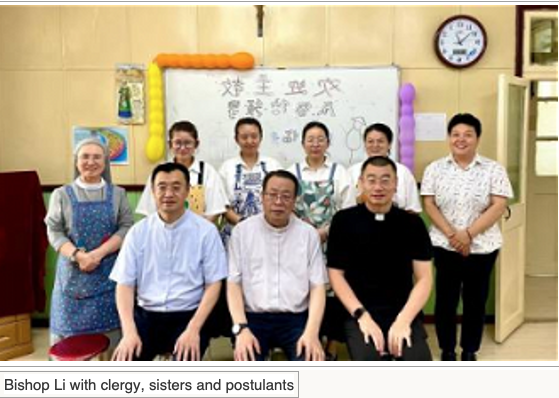
China: Congregation of St Joseph welcomes four postulants
Aug 22nd, 2023
Source: Fides
The Congregation of Saint Joseph of the Diocese of Beijing, China's first native Congregation of Sisters, welcomed four young postulants a few days ago in the presence of Bishop Joseph Li
Shan.
After a warm welcome from the congregation and the diocese, the young postulants introduced themselves and spoke about their vocation
journey during the ceremony, while Bishop Joseph Li spoke about the possibilities of the fruitful experiences of consecrated life.
Referring to the current situation in the diocese and the lack of new religious vocations, the Bishop of Beijing encouraged the young
postulants to persevere in their aspiration to follow God's call and to continue joyfully on the path to which they are called.
The Bishop recalled that only in joy can the baptized accept the mission to which they are called, which is to proclaim the Gospel of Christ
to the world.
The Sisters' Congregation of Saint Joseph was founded in 1872 as the first native women's religious order in the Diocese of
Beijing.
On May 2nd, 2022 the Congregation celebrated its 150th anniversary.
In 1870, Louis-Gabriel Delaplace, a Lazarist priest and bishop of Beijing, had the inspiration to found a native Chinese order. Delaplace
was also one of the Council Fathers the First Vatican Council and thus had the opportunity to present his proposal during the Council in Rome.
Two years later, with the help of the Canossa sisters, the congregation was founded, which today includes sisters from various Chinese
provinces. According to the will of the Founder, the main purpose of the Congregation is service (ecclesiastical and social) and mission.
In 1941, the congregation reformed its structure, changing its statutes and religious dress, and also added the vow of poverty (previously
the sisters only took the vows of obedience and chastity).
The date of the religious profession has always remained linked to the Solemnity of Saint Joseph.
Today, the sisters' activity extends above all to the fields of health and education, always being available for the concerns and needs of
the diocese.
As a result of the Cultural Revolution, the Congregation was dissolved for 30 years. It was relaunched in 1986 with six young women from the
Beijing suburbs. There are currently 49 sisters.
During their training, they study Sacred Scripture, Church History, Fundamental Theology, Canon Law, Liturgy, Spirituality, Philosophy,
Church Music, Physics, Chinese Literature, Chinese Moral Tradition, Social Sciences and Foreign Languages.
The motto of the Congregation comes from Paul's first letter to the Corinthians: 'Although I am free in regard to all, I have made myself a
slave to all so as to win over as many as possible' 1 Cor 9:19.. and from the Gospel of Luke: When you have done all what you have been commanded, you shall say: We are useless servants; we have only
done our duty' Lk 17:10.
The path that the Congregation of Sisters of Saint Joseph has taken, even in difficult times, is a sign of hope for the entire Catholic
Church in China.
END
July Updates 2023
8 Updates- Please click the blue address link.
5. Cardinal Chow, hope for Hong Kong and a bridge to China
7. ASIA/CHINA - Bishop Joseph Shen Bin administers the sacraments of Christian initiation to 34 catechumens: “Be a blessing to all”
END
June Updates 2023
7 Updates- Please click the blue address link.
1. Gratitude and praise: the parish dedicated to the Sacred Heart celebrates the 150th anniversary of its foundation
19th June 2023
2. Diocese welcomes eight new permanent deacons
16th June 2023
https://www.examiner.org.hk/2023/06/16/diocese-welcomes-eight-new-permanent-deacons/news/hongkong/
3. A precious (and useful) "database" on the historical evolution of Catholic dioceses in China
15th June 2023
4. Marian processions, Confirmations, Masses and Prayers: how Chinese Catholics experienced the World Day of Prayer for the Church in China
24th May 2023
5. Bishop Joseph Shen Bin leads the pilgrimage to Our Lady of Sheshan, reciting the prayer written by Benedict XVI
19th May 2023
6. Historic trip of bishop of Hong Kong to Beijing is the first in three decades
18th April 2023
7. Sister Corr one time editor of China Bridge bids final farewell
END
May Updates 2023
8 Updates- Please click the blue address link.
1. A Bridge to Walk: An interview with Msgr. Stephen Chow, Bishop of Hong Kong
12th May 2023
End
April Updates 2023
8 Updates- Please click the blue address link.
1. Farewell to Peter Lin Jiashan, Archbishop of Fuzhou
14th April 2023
http://www.fides.org/en/news/73651-ASIA_CHINA_Farewell_to_Peter_Lin_Jiashan_Archbishop_of_Fuzhou
2.The Easter Triduum celebrated again in the Chinese dioceses, in the sign of communion
7th April 2023
3. Chinese Catholics donate for the poor ahead of Easter
6th April 2023
https://www.ucanews.com/news/chinese-catholics-donate-for-the-poor-ahead-of-easter/100922
4. Installation of Bishop Shen Bin in Shanghai
4th April 2023
http://www.fides.org/en/news/73629-ASIA_CHINA_Installation_of_Bishop_Shen_Bin_in_Shanghai
5. Deaths due to pandemic, premature deaths, decrease in vocations: the ageing of Chinese clergy is accentuating
3rd April 2023
6. Palm Sunday: Catholic communities promote the seventh National Collection Day
1st April 2023
7. Chinese Catholics help elderly, students during Lent
28th March 2023
https://www.ucanews.com/news/chinese-catholics-help-elderly-students-during-lent/100814
8. Church of Asia: ‘Taking off our shoes’ expresses synodal journey.
27th March 2023
END
March Updates 2023
3 Updates
1. Christianity and women in Matteo Ricci's China
2. Give thanks to God on the peaks of Mount Lú. Lenten pilgrimages to the Marian shrine of Lushan for the feast of Saint Joseph.
3. A meeting planned for April between Mgr Chow, Bishop of Hong-Kong, and Mgr Li, Archbishop of Beijing.
1.
Christianity and women in Matteo Ricci's China
19th March 2023
In the Jesuit magazine, "La Civiltà Cattolica," Fr. Federico Lombardi retraces a little
known aspect of the early Jesuits' mission in China: the baptisms and hidden apostolate
of women in a society where social control over them was tight. And of one of them -
Candida, granddaughter of Xu Guangqi - he recounts her apostolate and reputation for
holiness.
Rome (AsiaNews) - The rediscovery of the missionary style of Matteo Ricci and other European Jesuits in the Ming court between the 16th and 17th centuries is a theme that has long returned to prominence in discussions on Christianity in China. Even Pope Francis has often pointed to it as a model for the meeting of dialogue and evangelization.
There is one aspect, however, that remains little known about this chapter of Church history in Asia: the way in which - in the shadow of the literati, in a society in which they generally enjoyed very little space - even some Chinese women were able to receive baptism and become missionaries themselves through their witness.
Their stories are the focus of an article by Jesuit Fr. Federico Lombardi, former director of the Vatican Press Office, published in the new issue of the magazine "La Civiltà Cattolica" and written on the basis of the writings Jesuit missionaries in China left behind about their work.
It was by no means a foregone conclusion that Christianity would also reach women. In fact, as Fr. Lombardi recalls, "in Chinese society women had to lead an extremely withdrawn life and under very strict control of their parents, husbands and family members. Therefore the direct relationship of missionaries with them was practically impossible, indeed to be avoided, so as not to arouse rejection and suspicion. Especially since the Jesuits soon abandoned the clothes and lifestyle of the bonzes to assume that of the literati, and while the women of the people frequented the bonzes, the social control over women in the educated classes was most rigid."
As early as 1589, when in their first residence in China in Zhaoqing Fr. Ruggieri and Fr. Ricci had accomplished no more than 70-80 baptisms, there is mention of the presence in that very small community of "some honored matrons, who give great credit and sustain Christianity in the houses."
But it was probably around 1601, Fr. Lombardi notes, "that a real turning point took place, welcoming the desire of the neophytes that their wives also be baptized. It was in particular Fr. Nicolò Longobardo, active in Shaozhou, who pleaded the cause, obtaining Matteo Ricci's assent."
This did not erase the practical difficulties, but the Jesuits found that grace worked going beyond all obstacles. The funds of the time recount what happened with a Mandarin who had decided to be baptized: "His mother and grandmother overtook him, preceding him in baptism, while he at the same time acted as her catechumen and catechist. After they had heard the Doctrine, he went and reported everything to them; and so slowly they catechized very well. They were baptized on St. Anne's Day, in the presence of two of their sons. Father gave them the necessary instruction and questions and found them very well catechized. Their mother was named Mary and their grandmother Anna."
Fr. Lombardi adds that sources report how these baptized Christian women "loved to gather also with other women of lower social status, even peasants, who had also become Christians, treating them 'as sisters,' and this was an occasion of 'great wonder.'"
At one point in time, women would also take on an important role in the spread of Christianity in the Beijing court: it happened when during the reign of the last Ming emperor, Chongzhen, the German Jesuit Adam Schall von Bell managed to enter into a relationship with the eunuch Wang, a man of rare wisdom and virtue, who converted to Christianity and was baptized with the name Joseph. Through him the Christian faith spread among the ladies of the court, whom he catechized and eventually baptized, following Fr. Schall's instructions.
By 1640 these Christian ladies of the court had grown to as many as 50 and were being guided spiritually by the Jesuit in writing through Joseph himself, the only one who could have contact with them. In 1644, however, would come the end of the Ming dynasty, which was defeated by the Qing; at that point, this community, too, dispersed as the women returned to their families.
It was not only a hidden contribution, however, that of women to the spread of Christianity in China. And among them, Fr. Lombardi notes, there were some who, "thanks to favorable family and social conditions, became true pillars of a dynamic Church."
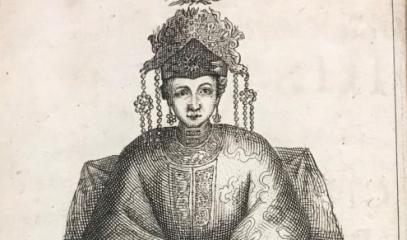
The best-known name is that of Candida, one of the daughters of James, himself the only son of Xu Guangqi, the best-known and most influential disciple and friend of Fr. Matteo Ricci, who became a Christian in 1603. Her story was told in Europe as early as 1688 by Fr. Philippe Couplet, her spiritual father, in a book entitled "History of a Chinese Christian Lady."
Growing up in Sungkiang (Songjang, today a district of the Shanghai metropolis), Candida was given in marriage to a wealthy and influential man who was pagan but respectful of her Christian faith. However, she was widowed at the age of 30 after bearing him eight children. It was precisely this condition-along with her choice not to remarry because she "desired only to be God's" - that enabled her over the next 40 years to live a very active life serving the Christian community.
While not neglecting the obligations of her family, Candida was a master at making embroidery on silk fabrics, which she made with her sisters, daughters and maids, and thanks to which she collected no small sums, which, wrote Fr. Couplet, "she secretly employed, according to the counsel of the Gospel, to help missionaries, the poor, to build churches and chapels and everything necessary for pious exercises of the new Christians."
Thus she did not draw on family property, which was to be the inheritance for her children, but on the fruits of personal labor, which she kept in free and proud conscience to devote to charity.
Between 1647 and 1665 Fr. Francesco Brancati, a Palermo Jesuit and a great apostle of the Christian community in Shanghai, built as many as 90 churches and 45 oratories. A work to which Candida collaborated with offerings, sacred furnishings and other initiatives. But his apostolate was truly all-around, with special attention to women.
Fr. Lombardi writes, "She helped missionaries understand that to convert women, who cannot go to church, they must write piety books in Chinese. Which the Jesuits actually do, while Candida goes out of her way to distribute and give them to all the women she can reach. She also insists that there be a church specifically dedicated to women, where at designated times they can go together to attend the celebration of the Eucharist, without the presence of any man other than the priest and an altar boy, and where the priest can preach, although facing the altar and not the women faithful present."
"If her great grandfather, Xu Guangqi, had demonstrated in deeds that the Christian faith could inspire the commitment of a whole life dedicated to science, wisdom and the service of his country, up to the highest degrees of responsibility," Fr. Lombardi further observes, "his granddaughter Candida demonstrated that the Christian faith could animate the commitment and responsibility of a Chinese woman to the point of serving as a model and inspiration for all her countrymen."
Candida died in 1680. According to the custom of the time, she had a silver cross coined with her profession of faith: "I believe, hope, love the Lord of Heaven, a God in three persons, leaning on the sacred merits of Jesus. I firmly believe and fervently hope for the forgiveness of my sins, the resurrection of my body and eternal life." Fr. Lombardi writes that Fr. Couplet, in concluding Candida's biography, noted, "All the people of the city of Sungkiang regarded this woman as a saint." He adds, "So do we."
Pictured: Candida as portrayed in the biography deedicated to her by Fr. Couplet in 1688
ECCLESIA IN ASIA IS THE ASIANEWS NEWSLETTER DEDICATED TO CHRISTIAN COMMUNITIES IN ASIA. WOULD YOU LIKE TO RECEIVE IT EVERY SUNDAY VIA E-MAIL? SUBSCRIBE TO THE NEWSLETTER HERE.
____________________________________________________________________________________________________________
2.
Give thanks to God on the peaks of Mount Lú. Lenten pilgrimages to the Marian shrine of Lushan for the feast of Saint Joseph.
15th March 2023
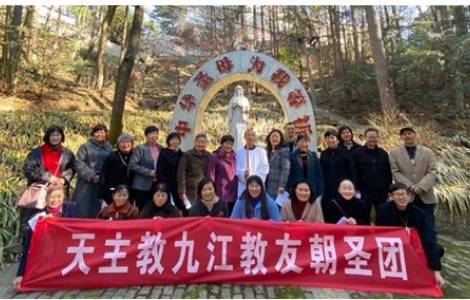
Lushan (Agenzia Fides) - Lushan, "Mount Lú", is a mountain located in the district of the same name, south of the city of Jiujiang, in the Chinese province of Jiangxi. From a
distance, you can admire countless peaks that blend into the clouds with enchanting landscapes. The entire area, recognized as cultural heritage by UNESCO, is now part of a vast natural park known
internationally. It was precisely in this region that French Lazarist missionaries erected the Church dedicated to the Assumption of Mary in 1894, with the intention of offering a spiritual oasis to
the Catholic communities of the regions of Shanghai, Nanjing and Wuhan, as well as all the cities in Jiangxi province. This is where the Catholic community in Jiujiang, Jiangxi province, also brought
its faithful today for a Lenten pilgrimage and the days leading up to the feast of Saint Joseph, who is also venerated as Patron of missions in China. Way of the Cross, adoration, sacrament of
penance to retrace the life of Jesus who, in his passion, entrusted himself to the embrace of the Father.
The parish priest, Father
Pang Rui, and the nuns led the pilgrimage, inviting everyone to walk in the footsteps of Saint Joseph, "to learn the virtues of obedience to the Lord, his fervent piety, dedication to the service of
the Holy Family".
In 2013, the Catholic
community in Jiangxi also erected the Matteo Ricci Spiritual Center of Lushan in the Church of the Assumption of Mary. In ten years, that of Lushan has become one of the most appreciated shrines of
Chinese Catholics, and it is also frequented by many non-baptized people, because the Center also offers hospitality to all those who wish to spend a moment of peace and contemplation in an
environment that soothes the soul, far from the hustle and bustle of megalopolises. People can walk the Stations of the Cross, pray and meditate in front of the statues of the Virgin and admire the
marvels of the Lord's creation. All this is also possible thanks to the vision and hard work of the missionaries.
The style of construction of
the Sanctuary (from the church to the Spiritual Center) is simple and linear. The stones of the church tell the story of an unbroken experience of faith, lived even in the midst of tribulation. For
130 years, and with a rhythm that has intensified in the last decade, especially thanks to the call of the Holy Year of Mercy, the Sanctuary has been a constant destination of pilgrimages by
communities, families, individual travellers. Groups of internal immigrants, priests and nuns - those of the diocesan Congregations of the Holy Spirit, of the Sacred Heart of Jesus, of the Franciscan
Missionaries, of the Little Sisters of Saint Thérèse of Lisieux... - arrive from all over the province and the large surrounding towns, to ask Christ for the grace to renew their apostolic and
missionary fervor, at the service of all the people.
Thus, every day, the songs of
the Ave Maria, the Alleluia, the Dona nobis pacem sung by the various parish choirs rise in the clouds of Mont Lu, to give thanks to Mary and to the Father who is in Heaven. (NZ) (Agenzia
Fides)
_________________________________________________________________________________
3.
A meeting planned for April between Mgr Chow, Bishop of Hong-Kong, and Mgr Li, Archbishop of Beijing.
11th March 2023
From April 17, Msgr. Stephen Chow Sau-yan, Bishop of Hong Kong, will travel to Beijing for five
days with a Hong Kong delegation to meet Msgr. Joseph Li Shan, Archbishop of Beijing. The
meeting will take place at the latter's invitation, and Bishop Chow confided that he accepted "in a
spirit of brotherhood in the Lord". The Jesuit bishop added that this visit “recalls the mission of the
diocese of Hong-Kong to form a bridge and to favor exchanges on both sides”.
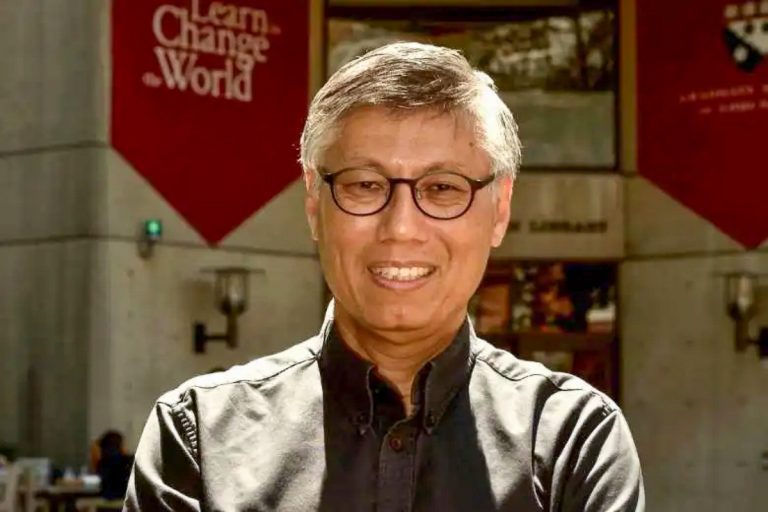
Bishop Stephen Chow Sau-yan, Bishop of Hong Kong
Bishop Stephen Chow Sau-yan, Bishop of Hong Kong, is due to visit the Chinese capital next month at the invitation of Bishop Joseph Li Shan, Archbishop of Beijing, in order to promote exchanges and communications between the two Catholics of the two Chinese regions, according to an official statement issued on March 9 by the diocese of Hong Kong. The two bishops will spend five days in Beijing starting April 17.
Bishop Chow accepted this invitation “in a spirit of brotherhood in the Lord”. The Jesuit bishop underlined that this visit “recalls the mission of the diocese of Hong-Kong to form a bridge and to favor exchanges on both sides”. Mgr Joseph Ha, auxiliary bishop of Hong-Kong, Father Pierre Choy, vicar general and Wong Ka-Chun, assistant to Mgr Chow, will accompany him during this visit to Beijing.
In addition to the meeting with Bishop Li, the Hong Kong delegation will also meet with other local bishops, as well as Chinese clergy and laity, according to the statement posted on the diocesan news site Sunday Examiner . The team will also visit the major seminary in Beijing and other major institutions related to religious affairs.
Upon his arrival in Beijing, Bishop Chow will participate in a vigil and celebrate a Mass in the Cathedral of the Immaculate Conception in Beijing. During his stay, he will also visit the tomb of Father Matteo Ricci, an Italian Jesuit missionary, recently declared venerable. The team must also meet various organizations supporting cultural exchanges.
“A bridge between the government and the Church of Hong Kong”
The last meeting of the Beijing and Hong Kong clergy took place during the weeks preceding Bishop Chow's episcopal ordination in 2021. On this occasion, the latter confided that he hoped "to be a bridge between the government and the Church of Hong Kong, and between the Catholic Church, Christian denominations and other religions”.
Chinese Catholics are currently divided between the official "patriotic" Church and the "underground" Church. For decades, the appointment of bishops in China has been a subject of tension between the Vatican and China, as official diplomatic ties were cut after the communists came to power nearly seven decades ago. In 2018, the Vatican signed a two-year provisional agreement with Beijing, which was extended in 2020 and 2022. Critics of this agreement speak of a “betrayal” of Catholics who remained faithful to the Vatican despite pressure and persecution.
Despite this, Pope Francis explains that he wants to continue to "dialogue" with China despite the difficulties. Through this agreement, the Holy See would seek to unite the millions of divided Chinese Catholics. However, many voices claim that China exploited the provisional agreement in an attempt to dismantle the underground Church. The diocese of Hong Kong, which covers the entire former British colony, has around 400,000 Catholics for a population of nearly 7.4 million.
(with Ucanews)
End
February Updates 2023
6 Updates
1. Chinese Catholic 'Faith Weekly' calls for prayer and donations for earthquake victims.
2. The death of Sr. Jiang: a century of fidelity to the Gospel in China.
3. New priests for Chinese dioceses, called to serve the Lord's Church "with humility and courage”.
4. Cardinal Zen hospitalized in Hong Kong after returning from Benedict XVI’s funeral.
5. Three newly ordained deacons for the Diocese of Zhouzhi.
6. Cardinal Zen appeals conviction in Hong Kong court.
1.
Chinese Catholic 'Faith Weekly' calls for prayer and donations for earthquake victims.
Agenzia Fides: www.fides.org/en
8th February 2023
Beijing (Agenzia Fides) - A strong appeal for prayer and solidarity in favor of the Turkish and Syrian populations affected by the disastrous earthquake was launched immediately after the first tremendous earthquake on Tuesday, February 7 by the online version of Faith Weekly (Xinde), the most widely circulated Catholic bulletin in Chinese. "Prayer and solidarity charity are the best way to face and overcome difficult situations", reads the appeal, which refers to the experience of persecution, pandemic and earthquake in China. The website reports with news and current photos from those devastated by the earthquake areas and publishes the message of Pope Francis to the two apostolic nuncios in Syria and Turkey Priests, religious and lay people from the Christian communities affected by the earthquake also have their say, lamenting the damage to the churches and accompanying the difficult rescue and recovery work and report on the tragic number of victims and the difficulties in protecting children and the elderly in particular from the cruel cold. The Chinese Catholic communities are invited to gather to pray the Rosary for their Turkish and Syrian brothers and sisters, and to organize collections of goods and aid to be sent to the areas affected by the earthquake.
The Catholic portal has
always been an effective "reservoir" of Catholic solidarity in China and thus takes on tasks that are otherwise covered by Caritas offices. "The whole world," the website reads, "is one family, let's
pray for the people of the two countries affected by the disaster and hope that they will soon be able to resume their normal lives and build a better home."
The appeal launched by Faith
Weekly was well received. In church services across the country, donations are collected and prayer requests are read out for the earthquake victims.
"Prayer and the collection of
goods for the peoples affected by the terrible earthquake, also in response to the Pope's appeal, is a reflection of the communion in faith and in the community with the Church of Rome", Fr Giuseppe
Wang tells Fides.
____________________________________________________________________
2.
The death of Sr. Jiang: a century of fidelity to the Gospel in China.
AsiaNews www.asianews.it
7th February 2023
The diocese of Nanjing mourns the death of a 104-year-old nun. Already in 1945, before the advent of the Communists, she had taken vows for the Daughters of Charity. Sent to work in the factory during the Cultural Revolution, she said of that very hard time: "I never lost hope because I had faith in God". It was only at the age of 64 that she was able to return to her ministry in the city of Wuxi. In 2000, she had the joy of meeting John Paul II in Rome.

Nanjing (AsiaNews) - Nearly eighty years of religious life lived through even the most difficult times for Catholics in China. This is the story of Sr. Jiang Lihua, a religious sister who died yesterday in the Chinese province of Yangsu.
Born on 29 December 1918, she was 104 years old when she died (calculated as 106 according to the Oriental count, based on lunar birthdays). Born into a Catholic family for generations, she joined the congregation of the Daughters of Charity in Shanghai in the 1940s and took her first vows in 1945.
She was therefore one of the faces - by now increasingly rare in China - of that generation of priests and nuns formed before Mao's Communist Revolution and who, after the expulsion of all foreign missionaries, found themselves having to live the test of fidelity to their vocation in the new context that had been created from the 1950s onwards.
Sr. Jiang had told her story personally a few years ago in an interview and in a video published by the UcaNews agency, during a stay in Hong Kong. The elderly nun - already then on the threshold of one hundred years of age - recalled the harshest years, those of the Cultural Revolution, when in the ideological fury of 1966 she too was sent back by the Red Guards to her home village in Yangsu. Even some of her relatives, she recounted, viewed her with suspicion because she had been a nun. She was sent to work in a food factory.
"Life was worthless in those days," she recalled. "No one paid any regard to you. "Someone told me to get married but my sister did not agree. I did not want it too. I believe God would arrange everything for me."
Her strength in those years was fidelity to prayer: "I did not recite the prayers in front of others," she still recalled, "but deep in my heart, without texts but from memory, I asked God's help not to be tempted to fall and to have the possibility of returning to my congregation. I never lost hope because I had faith in God."
That wish could come true with the first openings of the 1980s: it was then that Sr Jiang, then 64, was able to return to work for the Church in the city of Wuxi in the diocese of Nanjing. And she continued to faithfully carry out her ministry there ever since.
Of those early years, she recalled in the interview with UcaNews the challenge was to return to transmitting the faith: "Every summer we organised catechism and Bible study courses for children, with about 200 participants."
On the occasion of the Jubilee of 2000, thanks to a special permit, she was able to travel to France to the mother house of the Sisters of Charity. During that trip, she also went on pilgrimage to Rome and had the opportunity to meet John Paul II personally. On her return to China, however, she had kept the photograph of that meeting hidden for some time, for fear of possible sanctions by the local authorities.
In 2016, reflecting on her ministry she said: "I cannot make any difference to the world at this age but I believe that God has his own plan for the Catholic Church in China."
____________________________________________________________________________
3.
New priests for Chinese dioceses, called to serve the Lord's Church "with humility and courage”.
Agenzia Fides: www.fides.org/en
7th February 2023
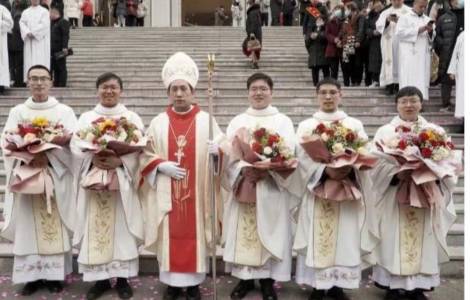
Rome (Agenzia Fides) - On the Feast of the Presentation of the Lord, in several dioceses in mainland China, new "workers in the Lord's Vineyard" were ordained and presented to the communities to which they will be called to exercise their priestly ministry.
On Thursday, February 2,
Bishop Joseph Sun Jigen ordained five new priests in the Diocese of Yongnian (now Handan), Hebei Province. The new priests were trained at seminaries in China:
three of them attended Hebei
Provincial Seminary, the other two at Shenyang Seminary. More than 130 priests concelebrated the ordination liturgy, presided over by Bishop Sun. The mass was attended by hundreds of seminarians,
nuns and lay people.
Also on February 2, Bishop
Joseph Huang Bingzhang of the Diocese of Shantou consecrated new priest Chen Jiaying, who was trained at the Beijing Seminary. Due to the measures still in place to combat the pandemic, only 400
priests, seminarians, nuns and lay people were able to attend the ordination liturgy. In his homily, Bishop Huang encouraged the new priest to live his priestly vocation in following Jesus, to face
trials with humility and obedience and bravery, and to serve the Lord's Church with joy.
____________________________________________________________________
4.
Cardinal Zen hospitalized in Hong Kong after returning from Benedict XVI’s funeral.
Catholic News agency
Rome Newsroom,
1st February 2023
Cardinal Joseph Zen has been hospitalized in Hong Kong after his health deteriorated upon returning from Benedict XVI’s funeral in Rome.
The 91-year-old cardinal wrote on his blog on Jan. 31 that he is receiving treatment in the hospital after experiencing difficulty breathing.
Zen said that the doctors have already conducted many examinations and ruled out that he does not have a bacterial infection in his lungs as he experienced in 2016 when he was hospitalized for three weeks.
“You have not heard from me as I have been staying in the hospital. Please rest assured, Hong Kong’s most senior doctors are taking care of me,” he wrote.
The former bishop of Hong Kong revealed that he had already been experiencing some health difficulties before he received permission from a Hong Kong court to travel to Rome for the Jan. 5 funeral of Benedict XVI.
Despite having inflammation in his shoulders, an aching back, and numbness in his hands, Zen said that he felt that he “could not give up the opportunity” to be present at the funeral.
“The funeral of Pope Benedict was very important to me; and like a miracle, God allowed me to go to Rome to attend: The court approved, the police let me get back my passport; the airline just had a flight so that I could catch the funeral in time, therefore, I felt that I couldn’t give up this opportunity and decided to go,” he said.
“When I went to Rome, I felt that I represented the whole of Hong Kong and the whole of China, expressing our respect and love to Pope Benedict XVI.”
After his four-day trip to Rome, the cardinal spent 10 days resting in Hong Kong, but his health unexpectedly continued to deteriorate, worsening on the first day of Lunar New Year, Jan. 22.
Zen shared the update on his health in a blog post titled “Letter to Inmates.” The retired cardinal has dedicated his time over the past 10 years to prison ministry in Hong Kong and has baptized several prisoners.
“Do not forget that we will never be separated in prayer,” he wrote to the inmates. “I will continue to pray for you, and please remember me in your prayers.”
_______________________________________________________________________
5.
Three newly ordained deacons for the Diocese of Zhouzhi.
Agenzia Fides: www.fides.org/en
30th January 2023

Zhouzhi (Agenzia Fides) - On the day when the Catholic Church celebrates the liturgical memory of Saint Thomas Aquinas, great theologian and Doctor of the Church, the Catholics of the diocese of Zhouzhi, in the Chinese province of Shaanxi, experienced with joy and gratitude the ordination of three new deacons, who will soon be ordained priests and will be able to fully live their priestly vocation at the service of their brothers and sisters and the entire local population.
The ordination liturgy of the
three new deacons, celebrated in the cathedral on Saturday January 28, was presided over by Martin Wu, Bishop of Zhouzhi, who was appointed by the Holy See in 2005 and officially installed at the
head of the diocese ten years after his ordination. About fifty priests took part in the liturgical concelebration, as well as parents of newly ordained deacons and numerous seminarians, nuns and lay
people from the surrounding dioceses.
Two of the new deacons are
only child. All three entered the Seminary after having had professional experience. Last September, the three new deacons had obtained their baccalaureate at the diocesan Seminary of the diocese of
Beijing. After the ordination ceremony, all three thanked their families, the community and the entire Catholic Church in China for the many forms of support and comfort they received throughout
their journey of formation and vocation, asking that the prayers of all continue to contribute to keeping alive in them the desire to work with joy and generosity to spread the proclamation of the
Gospel and bear witness to faith in Christ in the places and environments where they will be called to exercise their pastoral work.
Currently, 57 priests serve
some 70,000 baptized people in Zhouzhi Diocese. The life of the community revolves around pastoral initiatives, masses celebrated and the sacraments administered in 173 churches. In recent decades,
the diocese has also distinguished itself by its missionary fervor: 290 priests and seminarians and 208 sisters from the diocese of Zhouzhi are currently working to announce the Gospel in other
diocesan communities in the country. Ten continue their formation abroad, in France, Germany, Italy, the United States, England and the Philippines.
In the region which today
constitutes the diocese of Zhouzhi, the famous "Nestorian stele" was discovered in 1625. It attests to the arrival of the Christian proclamation in China by the missionary monks of the Church of the
East (of Nestorian ancestry) as early as 635 AD. The Shrine of the Mount of the Cross and the Shrine of Our Lady in China are located in the diocese.
On June 17, 1932, Pope Pius
XI created the Apostolic Prefecture of Zhouzhi. In 1951, five years after the establishment of the Catholic Hierarchy in China, the ecclesiastical district of Zhouzhi was elevated to the rank of
diocese. At that time there were 16 priests throughout the diocese, 14,000 baptized Catholics, 29 churches and 56 chapels. Zhouzhi Cathedral is dedicated to the Immaculate Heart of
Mary.
____________________________________________________________________
6.
Cardinal Zen appeals conviction in Hong Kong court.
14th December 2022
Catholic News agency
Rome Newsroom,
Cardinal Joseph Zen has filed an appeal with Hong Kong’s High Court following his conviction last month for failing to register a fund that helped pay for the legal fees and medical treatments of Hong Kong pro-democracy protesters.
The Hong Kong Free Press reported Dec. 14 that the 90-year-old cardinal and former bishop of Hong Kong filed an appeal of the verdict this week together with four other trustees of the 612 Humanitarian Relief Fund who were fined about $500 (HK$4,000) each.
Zen’s trial from September to November focused on whether it was necessary for the 612 Humanitarian Relief Fund trustees to apply for local society registration between 2019 and 2021.
Magistrate Ada Yim ruled on Nov. 25 that the fund was a “local society” and was subject to its rules. In her judgment, she said that the fund “had political objectives and thus it was not established solely for charitable purposes.”
Following the ruling, Margaret Ng, a lawyer and fund trustee who was convicted with Zen, highlighted that this was the first time that anyone had been convicted under Hong Kong’s Societies Ordinance for failing to register a society and said that the case is important for “freedom of association in Hong Kong.”
Along with Zen and Ng, singer-activist Denise Ho, cultural studies scholar Hui Po-Keung, and ex-legislator Cyd Ho have also appealed the conviction.
Sze Ching-wee, the former secretary of the 612 Humanitarian Relief Fund, has not filed for an appeal. Sze was arrested earlier in November under Hong Kong’s national security law. He has been released on bail and is required to report to the police in February.
Days before Zen filed for an appeal, a Hong Kong court sentenced Jimmy Lai, a Catholic pro-democracy advocate and former publisher of Hong Kong’s Apple Daily to an additional five years and nine months in jail for breaching the lease on one of his newspaper’s offices, according to AFP.
Lai, who has been jailed since December 2020 for his involvement in pro-democracy protests, also faces the possibility of being sentenced to life in prison under national security charges.
On Dec. 13, a Hong Kong court delayed Lai’s national security trial, initially scheduled for this month, until September 2023.
End
December Updates 2022
3 Updates
1. Father Vimal Tirimanna: Asian Church should become 'more Asian, less Roman'
2. The Beijinge: Story of the 'Jing: The Legacy of the Jesuits in Beijing.
3. "Signs of the Times": Social Media Mission.
1. Father Vimal Tirimanna: Asian Church should become 'more Asian, less Roman'
20th November 2022
UCA News - www.ucanews.com
By Christopher Joseph
The Churches in Asia need to seize the moment to stress the Asianness of the Church as Pope Francis encourages Church communities to become more grounded through continental contextual theologies, says Redemptorist Father Vimal Tirimanna, one of Asia’s leading theologians.
The 67-year-old professor of theology at the Pontifical Accademia Alfonsiana in Rome says the Federation of Asian Bishops’ Conference (FABC) should build on the theological foundations laid by yesteryear Asian theologians.
The priest, also a member of the Theological Commission of the General Secretariat for the Synod 2021-2024, also believes the synodal process will change "the Church upside down" if the process is taken seriously.
Father Tirimanna spoke with UCA News on Oct. 20 on the sidelines of FABC’s first general conference (Oct.12-30) organized in Bangkok as part of its golden jubilee celebrations. Excerpts from the interview:
What do you think the FABC has achieved in its 50 years?
The Federation of Asian Bishops’ Conference has a very good foundation thanks to our forefathers, who worked for it in the 1970-80s. We are celebrating 50 years now and I think we should get inspiration from those pioneers. Of course, we cannot go back and should not go back literally to what they were because the world has changed, and realities have changed. We should move on based firmly on the foundation they have already laid.
The essence they gave is the Asianness of the Church. Otherwise, tell me why should we meet as the FABC here. If we are not here to build on that essence of Asianness, it is all a waste of money, time and energy. We should cherish and develop a sense of Asianness in every aspect of the Church paying attention to the contemporary signs of the times. That, I believe, is the meaning of the existence of the FABC.
The FABC should continue to work. Let me be specific. We need to be Asian but as things stand today, the Church in Asia is not yet fully Asian. The FABC should continue to work and it has a lot of ground to cover. In the initial three decades of the FABC, it was bubbling with Asianness. But that Asianness has been gradually waning.
However, we cannot and should not go back to the 1970s and 1980s. We have to face today's reality and respond. Today's Asia is not the Asia of the 1970s or of the 1980s. So we have to be Asian according to today's Asia.
Is a fully Asian Church even possible?
We have to be Asian, otherwise, we don't need an FABC. Take for example the Latin American CELAM (the FABC equivalent in South America). It is through and through Latin American. And the FABC trails behind it. But as things stand, the reality is there is not much of a difference between European theology and the FABC’s theology. Of course, I'll be too naive to say that as a blanket statement. Certainly, there are certain Asian elements in our Churches. It's there … but much reduced. We can be more Asian, that’s what I am saying.
Why is the Asian Church attempting to reduce its Asian elements?
Frankly speaking, I don’t think that the Asian Church is consciously attempting to reduce her Asianness. However, the reasons for the lack of enthusiasm for being Asian can be traced to the pontificates of Papa Wojtila and Papa Ratzinger that perceived relativism as the major issue the Church has to respond to. During that time, most Asian bishops were trying to follow the Roman agenda, for obvious reasons. That's what Rome wanted. The freedom, which Paul VI gave, what Vatican II gave, was not there. Pope Paul VI allowed and encouraged the openness and freedom to be Asian, to be theologizing in the Asian way. But in the later decades, we see it being taken away little by little, little by little.
With the arrival of Pope Francis, we have gained much more space to be Asian because he's a Third-World man who would surely understand what it means to be in the Third World. He was the cardinal Archbishop of Buenos Aires in Argentina.
Secondly, he's promoting contextual theology. So, this is our Asian moment. We need to seize it. But I’m sorry to say I don’t see the enthusiasm and energy to do that. We can do much more than what we are doing because this is our moment. If we lose this, I wonder whether God will give us another moment like this.
What do you mean by contextual theology?
Any theology should help Christians to understand and respond to their faith in their own histories, in their daily life, in their culture, and in their socio-political nuances. These realities in Asia provide us with our context, and these realities are completely different from any other part of the world. Continental contextual theologies are local theologies to be developed as a faith-response to these continental realities. Roman or European theology will not be able to understand and respond to our realities in all their complexities. What we need is an Asian theology.
Vatican II has given us the freedom to develop these contextual theologies. This is the moment for us. I'm so happy that I'm living in this moment. I’m very hopeful about this space and freedom which Pope Francis reiterates. But will we use that space and the freedom to continue to build an Asian theology? I’m not sure. At the same time, I say this with a certain amount of hope. But I would have loved to have more inspiration from an Asianness than what we see today.
How will the universal Church benefit from these contextual theologies?
One of the finest theological elements which the FABC developed and contributed to the universal Church was the theology of inter-religious relations. The first document of the FABC Theological Advisory Commission was trying to understand how Christians could practice their faith without negating or looking down upon the beliefs of other religions in Asia, following the guidelines given by Vatican II.
I want to mention the names of a few Asian theologians here, who worked hard to lay the foundations for the FABC’s theology — Father Felix Wilfred from India and Jesuit Father Catalano Arevalo from the Philippines. I also remember Jesuit Father Aloysius Pieris of Sri Lanka. We may have differences of opinion with them. For example, I may not agree as a bishop with certain views they hold but their work for the FABC was seminal and indispensable.
Their main common point was that there are three main living realities in Asia: religions, cultures, and the poor. These founding fathers of FABC theology, of course, together with the pioneer FABC bishops, considered that Christian existence in Asia can be appreciated only through triple dialogue — with religions, cultures and the poor. These triple realities characterized Asia in the seventies, and they continue to characterize Asia even today and that will characterize Asia even tomorrow.
After all, our major Asian religions are here to stay. Whatever our other problems are, we are very religious still in Asia. Secondly, cultures. We are still culturally conditioned people more than any other non-Asian country, probably some African nations may be exceptions. Thirdly, our poor. They are not going to go off in the near future. So the dialogue with these three living Asian realities is a must. Of course, in our globalized world, all these are becoming social realities in many other parts of the world too. Asia is typically characterized by them.
I believe FABC will somehow regain its theological prominence because I believe in the active presence of the Holy Spirit. Otherwise, a conference like this will not have happened, a hope like this will have never been lit. However, I also think that we lack daring theologians of the caliber of those, who were there at the foundation. We don't have them today. Simple as that. We have theologians who mostly repeat what the early Asian theologians said, or what the Vatican is saying. We do not have theologians who can take Asian theology forward, but I believe that the Holy Spirit will lead the FABC in His own way.
What should be their priorities in this journey forward?
We have newer issues that beg for theological engagement here in Asia. We should have more time for dialogue with women, youth, and the environment. But please don't put those dialogues on par with the triple dialogue because the triple dialogue is what gives us our Asianness our Asian identity in theologizing.
Environmental issues are here as they are in other parts of the world. Issues of women and youth are also global. We should not lose what characterizes us. Have a dialogue with everybody, but let's be Asian. If you are not focused well, everything becomes important even with regard to dialogue. That means nothing is important. Have a dialogue but don't say they are Asian issues alone. But the issues of women in Asia are not that of Europe. So European solutions will not help Asian women. I think I have made my point clear.
I am in the Theological Commission, and Pope Francis is interested in Asian Churches. All the national episcopal synodal reports I read last month in Frascati together with my colleagues spoke about the role of women in the Church.
Here, I think of the report from Sri Lanka, which pleasantly surprised me as it said, women are the lifeblood of the Church in Sri Lanka. So we should give them more place, much more than now in ecclesial life. All that is true. But for heaven’s sake don't copy North American and European women's agenda and bring it here. For example, women's ordination. Is it an Asian issue? I'm asking that question. I won't say anything more. Are not women’s social subjugation, their oppression, and man-dominated societies in Asia typically our Asian issues? We also have issues of pushing women to be migrant workers in foreign lands.
____________________________________________________________________
2.
The Beijinge: Story of the 'Jing: The Legacy of the Jesuits in Beijing.
20th November 2022
CAP - Jesuit Conference of Asia Pacific
https://www.thebeijinger.com/
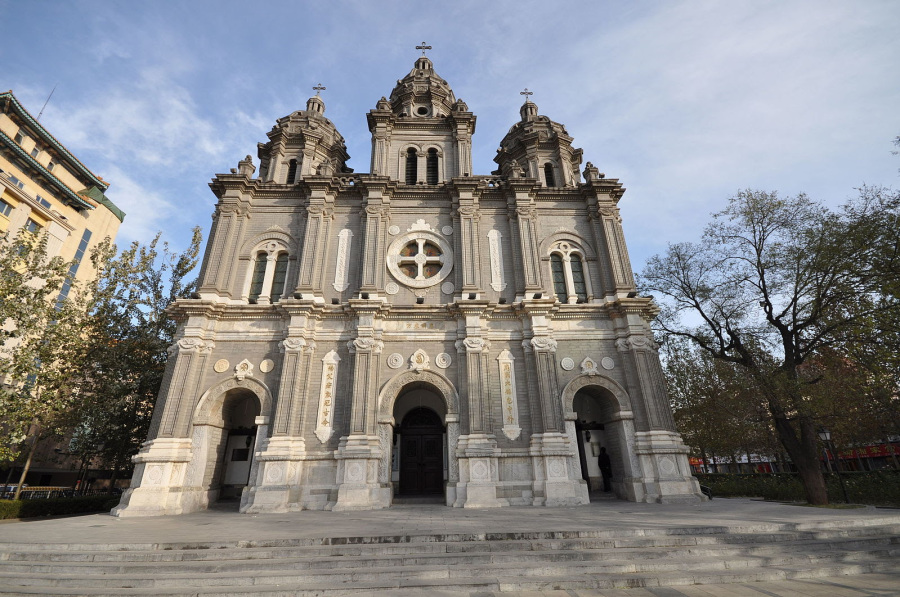
Few foreigners have left as much of a legacy in Beijing as the Jesuits who served at the Forbidden City. Many of the city's most famous churches began as chapels and residences for European missionaries living in Beijing from the 17th to the 19th centuries, which eventually grew into the impressive structures that still stand today. Here are a few of the more famous of the city's Jesuits and the sites associated with their history.
Jeremiah Jenne | Nov 20, 2022 10:55 am | Add a comment | 277 reads
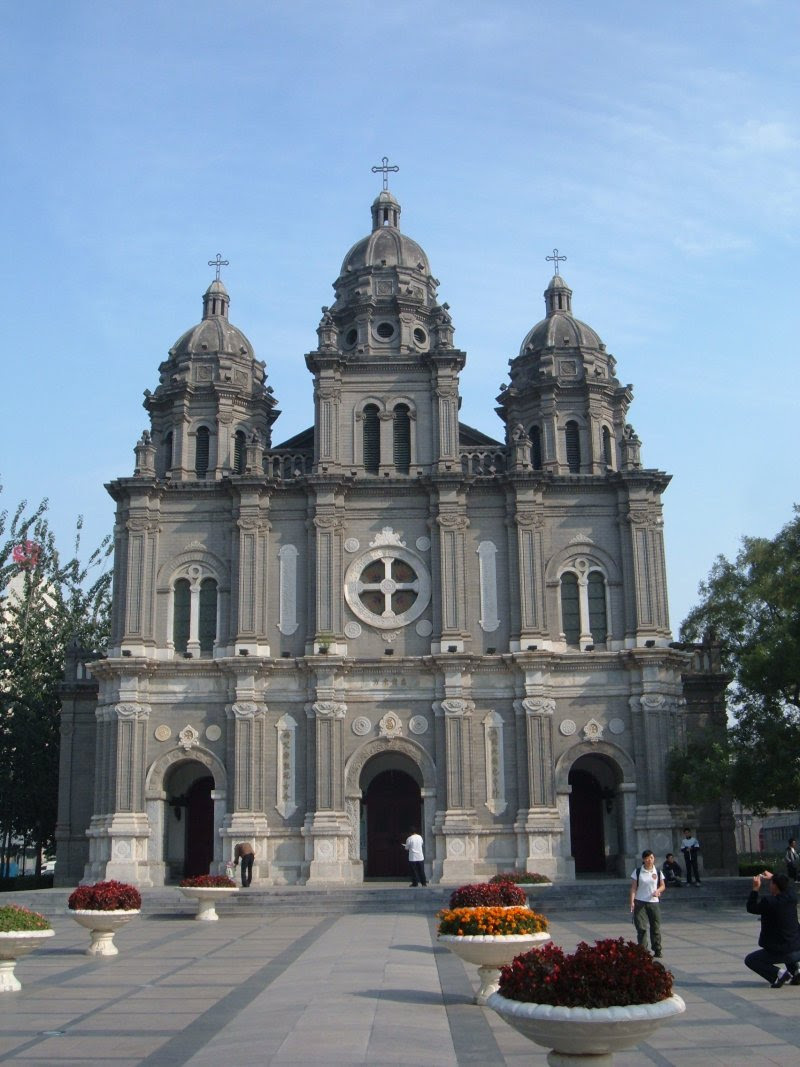
In 1598, the Italian Jesuit priest Matteo Ricci (1552-1610) stepped onto the pier at Tongzhou. Sadly, Ricci learned that it would be another 423 years before Universal Studios Resort would open. On a positive note, though, four centuries is approximately the wait time on busy weekends for Harry Potter and the Forbidden Journey. No matter; for Matteo Ricci had another Forbidden destination in mind.
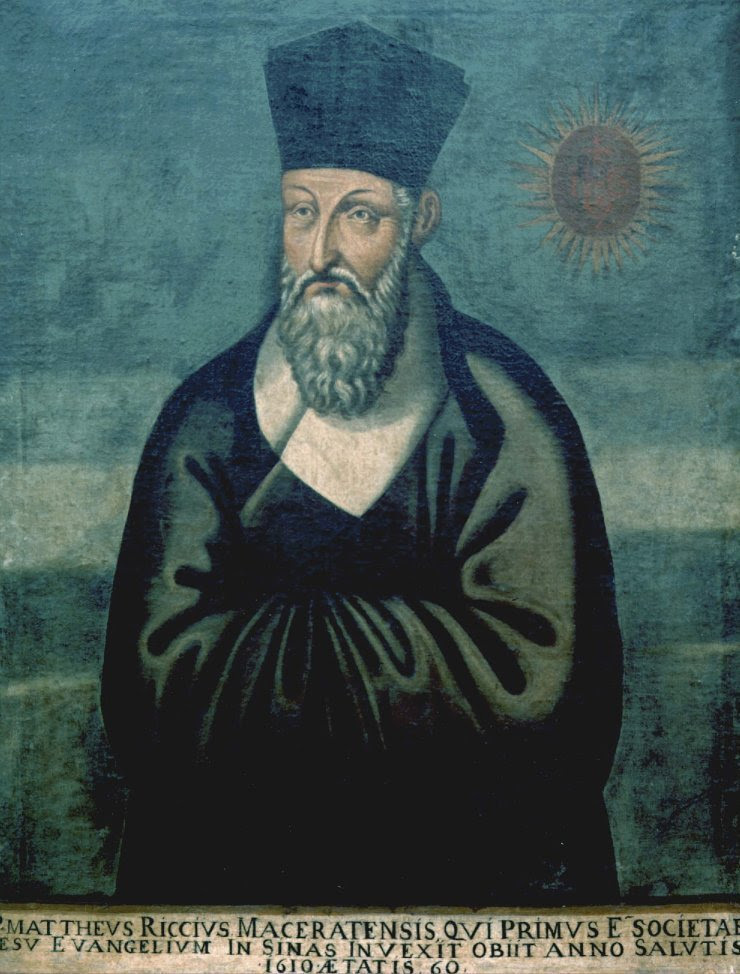
Ricci had been in China for 16 years, but 1598 was his first visit to the capital. Three years later, he was invited to the Forbidden City on the orders of the Wanli Emperor of the Ming Dynasty (1368-1644). Ricci never met the Wanli Emperor, who famously wasn't into things like "visitors," "work," or "leaving his bedroom," nor was there much imperial interest in Ricci's Catholicism.
Still, the European's skills as a cartographer, mathematician, linguist, and astronomer preceded Ricci. The court asked Ricci to stay in Beijing, beginning a tradition of Jesuit imperial advisers at the court of the Ming and later Qing (1644-1912) emperors that would last two centuries.
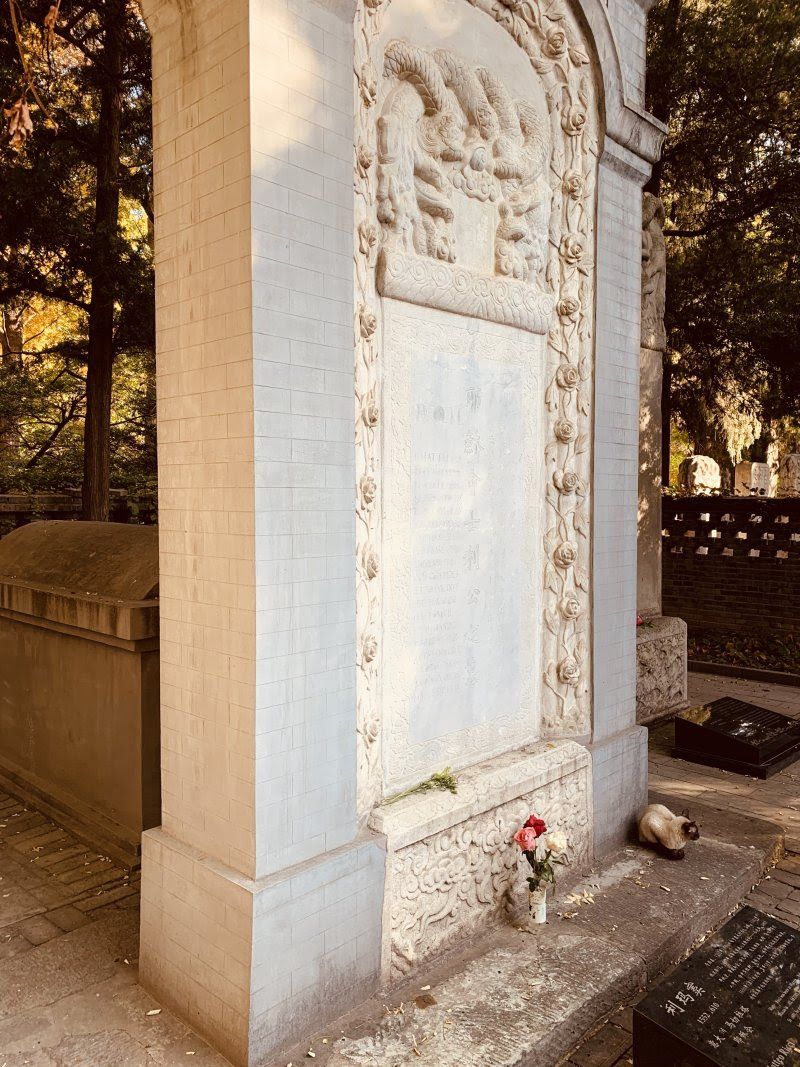
Zhalan Cemetery & South Church
Like many later Jesuits, including all the men on this list, Ricci is buried at the Zhalan Cemetery, located outside Fuchengmen Gate of Beijing, on the city's Westside. Legends have it the court repurposed land confiscated formerly held by a corrupt eunuch and gave it to the Jesuits to be used as a burial ground.
Access to this historic site can be tricky, as it is today the Beijing Administration Institute, one of the city's party (Think: "Communist," not "keg") schools. More accessible (slightly) is the Cathedral of the Immaculate Conception, also known as "South Church," near Xuanwumen, built on the site of a long-demolished chapel that served as Matteo Ricci's residence in Beijing from 1605 until Ricci died in 1610.
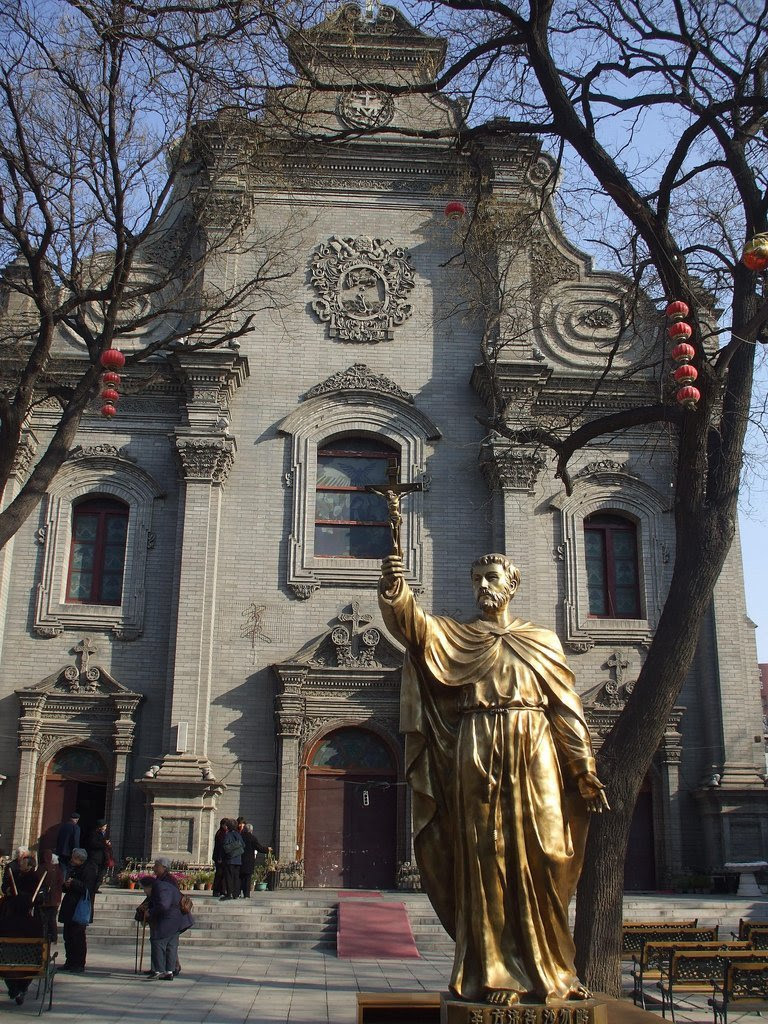
Ricci's Jesuit successors at the court witnessed the transition from the Ming to Qing dynasty in 1644. They deftly switched allegiances when it was clear that the Forbidden City would be under new ownership. German Jesuit Johann Adam Schall Von Bell (1591-1666) and his protege, the Flemish Jesuit Ferdinand Verbiest (1623-1688), made themselves useful to the new Manchu rulers by helping to perfect the imperial calendar.
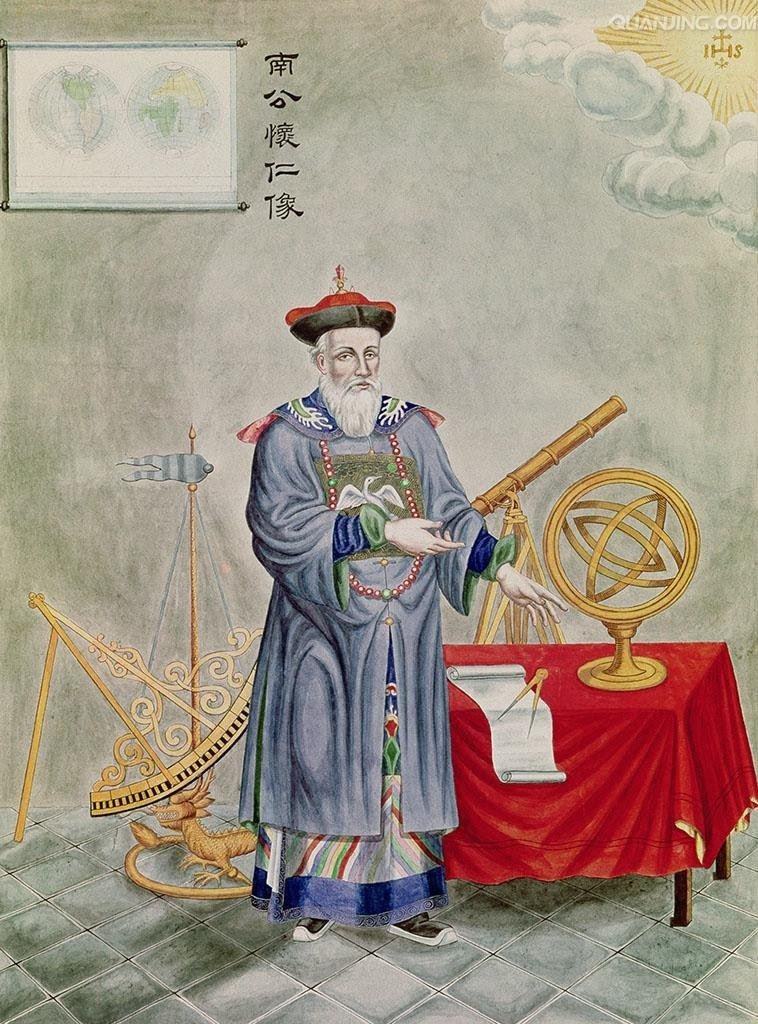
Schall Von Bell was close with the Shunzhi Emperor [r. 1643-1661]. After the emperor's death, political intrigue involving jealous rival astronomers led to Schall von Bell and Verbiest being imprisoned. Schall Von Bell died soon after, but Verbiest survived to challenge their accusers to an Astronomy Off, with the winner being named head of the calendrical bureau. Verbiest and his team won, and Verbiest became an adviser to the Kangxi Emperor [r. 1661-1722].

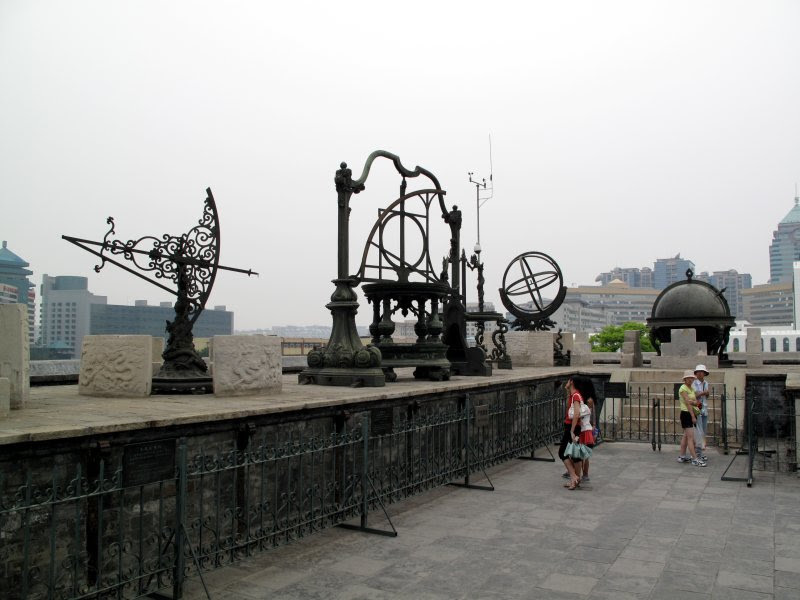
The Ancient Observatory
On top of a small surviving section of the old city wall, next to the Jianguomen interchange, is the former Imperial Observatory. In addition to the remains and replicas of the instruments used by the Jesuits and other imperial astronomers, there is a small museum featuring Adam Schall von Bell, Ferdinand Verbiest, and other Jesuit scientists.
Giuseppe Castiglione (1688-1766) was a Lay Jesuit brother (but not a priest) who served three emperors as a court painter, but it is his association with the last of these, the Qianlong Emperor, that has left a lasting legacy on the art and architecture of Beijing.
Castiglione arrived in Beijing in 1715, over a century after the death of Matteo Ricci. Adopting the Chinese name Lang Shining, Castiglione painted imperial portraits, commemorated military campaigns, and, perhaps most famously for tourists, helped design the Western-Style Palaces at the Yuanmingyuan.
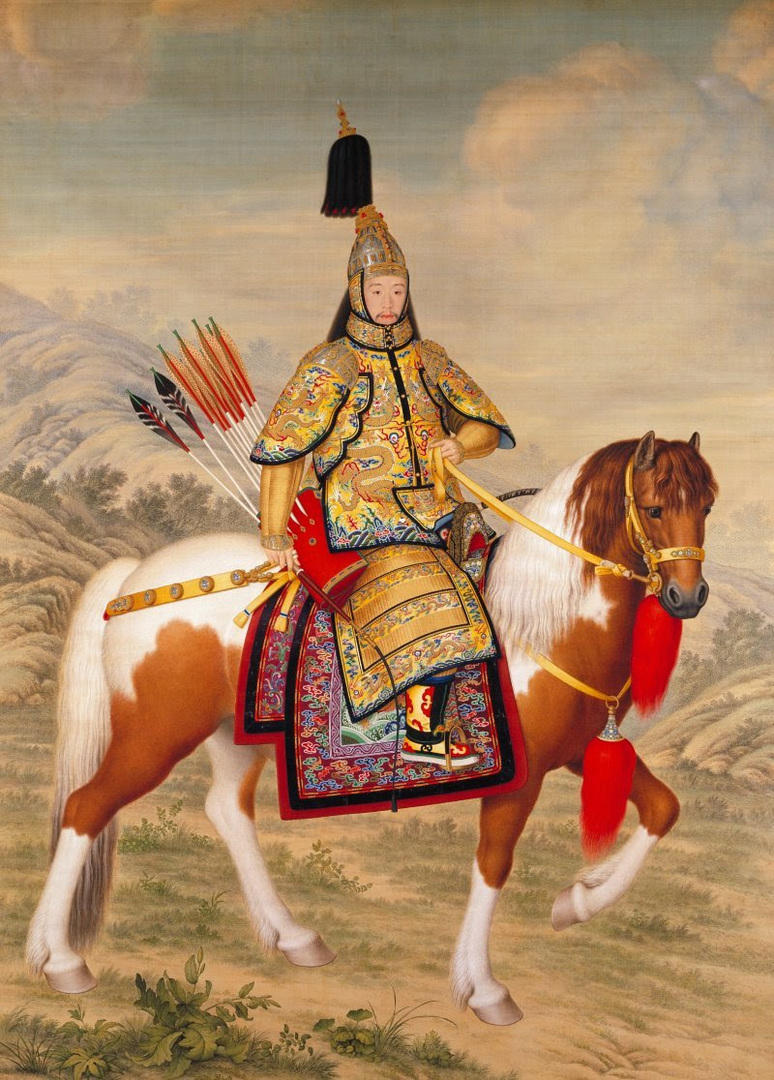
Yuanmingyuan - aka the Old Summer Palace
Castiglione worked at both the Forbidden City and the imperial residence at Yuanmingyuan. His paintings can also be found at the National Museum of China at Tiananmen Square. But the Western-style Buildings, even 160 years after their destruction by the Anglo-French Expedition of 1860, remain Castiglione's most lasting legacy.
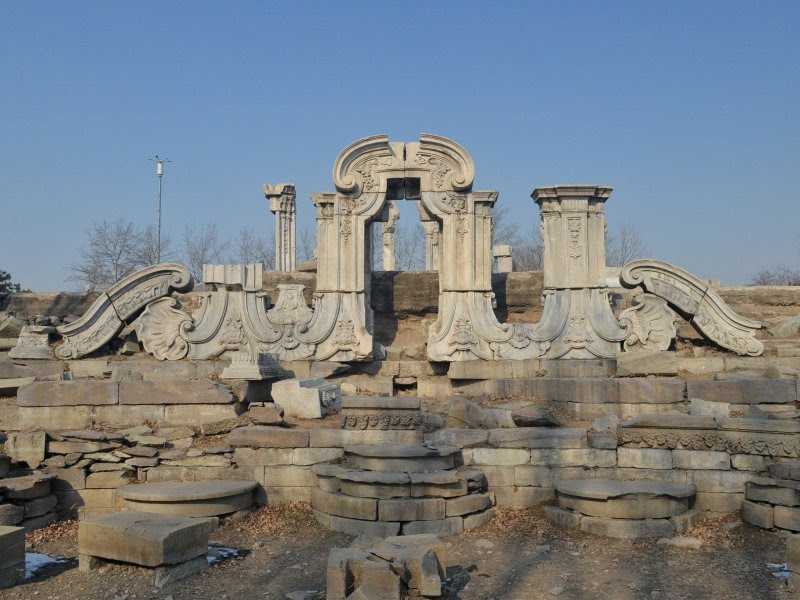
One wonders what the court painter thought when given the task of designing a European-themed play set for the Qianlong Emperor, although Castiglione would certainly not be the last foreign employee of a local organization to be asked to do things wildly outside their job description.
About the Author
Jeremiah Jenne earned his Ph.D. in Chinese history from the University of California, Davis, and taught Late Imperial and Modern China for over 15 years. He has lived in Beijing for nearly two decades and is the proprietor of Beijing by Foot, organizing history education programs and walking tours of the city including deeper dives into the route and sites described here.
READ: Story of the 'Jing: When Beijing's Most Famous Sites Opened Their Doors to the Public
Images: Wikimedia, Wikipedia, Jeremiah Jenne
_________________________________________________________________________________________________
3.
"Signs of the Times": Social Media Mission.
17th October 2022
Agenzia Fides - www.fides.org
ASIA/CHINA - "Signs of the Times": Social Media Mission
By: Marta Zhao
Beijing (Agenzia Fides) - For years, the daily life of a
large part of the Chinese population has been characterized by the use of the news app "Wechat" from the Chinese company "Tencent Holdings". The company, founded in 1998, has specialized in the
development of Internet services. “Wechat” is now installed on almost every Chinese mobile phone and has become a communication and information tool used by Chinese both at home and abroad. People
use the app to pay for groceries, get the result of the coronavirus test, and download the relevant certificate that certifies immunity.
As for the use of "Wechat", the Chinese Catholic
communities have also recognized the signs of the times and "Wechat" has become a valuable and reliable tool when it comes to spreading news about the initiatives and events affecting the everyday
church life in the ministry of proclaiming the gospel. This modern technological tool, used above all by the younger generations, has thus "updated" in its own way the image of the usual pastoral
dynamics of parishes and ecclesial communities. The "Wechat" accounts of parishes and church groups are often used by youth, who in this way personally participate in the mission of the church by
sharing spiritual content, prayers and community programs with their peers.
Dioceses, parishes, church groups and associations have
their own "Wechat" accounts, which they update daily. On the individual accounts you will find information about catechism courses, references to liturgies and community prayers (rosary,
commemoration of the dead, etc.), representations of the Christian faith also through works of art, posters of parish initiatives. Those responsible for church accounts create striking images and
video clips that become new tools to convey the gift of faith received, using languages and expressions that are considered familiar, especially to younger
generations.
The Parish of Our Lady of Mount Carmel in the Archdiocese
of Beijing, for example, accompanies the beginning of the Day of the Faithful with a passage from the Holy Scriptures published on Wechat. On October 7th, the day of Our Lady of the Rosary,
suggestive sacred images, music videos and the text for the rosary prayer were published on the parish account, along with videos with sacred hymns and the text to accompany the prayer of the Holy
Rosary. The publication of the texts and images with hymns via Wechat has not led to a sometimes not undisputed "digitalization" of parish life, on the contrary, many young people, after seeing texts
and images on the Wechat account, went to the parish to participate in person in the prayer of the Rosary. For some of them, this participation has become an opportunity to rediscover the beautiful
history of the parish, and to share this new knowledge through their personal accounts, pictures and small video clips taken at the church, which is also a testament that apps can be valuable and
useful when they become tools of an ecclesial life careful to use even the most modern means to proclaim the Gospel.
The Archdiocese of Beijing now uses "Wechat" as a normal
tool to communicate its pastoral and liturgical program and also offers practical advice on church activities and appointments. For example, this Monday, October 17, the Archdiocese's Wechat account
published the program for the Day of Remembrance of the Dead (November 2), including the times of the various Masses to be celebrated in the two Catholic cemeteries of the Archdiocese metropolis to
be celebrated.
END
October Updates 2022
4 Updates
1. Hong Kong media report the postponement of Card Zen’s trial.
2.The diocese of Zhouzhi celebrates ninety years of evangelization by renewing its missionary commitment.
3.Beijing tells new Catholic leaders to ‘fend off infiltration by foreign forces’.
4.China's Catholic leaders vow to accelerate sinicization.
1.
Hong Kong media report the postponement of Card Zen’s trial.
19th September 2022
AsiaNews - www.asianews.it
The trial was supposed to start today and be over by Friday, but the presiding judge contracted COVID-19. The cardinal and five other pro-democracy advocates are accused of running an unregistered charity and could at worse be fined. Experts believe that the original charge of undermining national security was dropped for fear of international reactions.
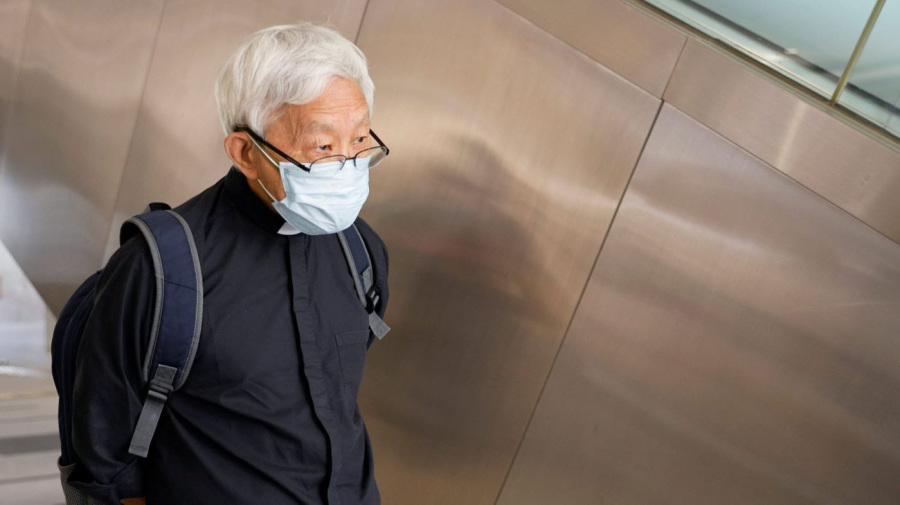
Hong Kong (AsiaNews) – The trial of Card Joseph Zen Ze-kiun and five important pro-democracy activists was supposed to start today at the West Kowloon Court but was postponed until Wednesday.
Local media, including Sing Tao Daily, report that the judge in charge of the case, Permanent Magistrate Ada Yim Shun-yee, contracted COVID-19.
A verdict was expected this Friday but it too could be postponed by a couple of days. The defendants are accused of improperly registering a humanitarian fund of which they were trustees.
On 11 May, police arrested Card Zen, Hong Kong’s archbishop emeritus, and the other defendants on the more serious charge of "collusion" with foreign forces, in violation of a draconian national security law imposed by Beijing in the summer of 2020 to silence the pro-democracy movement.
Without the indictment for undermining to national security, the defendants risk at best a fine of up to US$ 1,750.
In addition to the 90-year-old cardinal, the other defendants are the well-known lawyer Margaret Ng, singer-activist Denise Ho, former Legislative Council Member Cyd Ho, academic Hui Po-keung, and activist Sze Ching-wee.
Cyd Ho is already in prison for taking part in an unauthorised demonstration. Several other pro-democracy advocates, including Catholic media magnate Jimmy Lai, are also in prison on the same charge.
Until it folded in October 2021, the 612 Fund helped thousands of pro-democracy activists involved in the 2019 protests.
Card Zen and his co-defendants pleaded not guilty. According to their lawyers, the charity was not required to register under the Societies Ordinance.
The defence wants the ordinance to be interpreted in such a way as to take into account the right of citizens to associate as enshrined in Hong Kong’s Basic Law, which will go a long way to show how much freedom is left in the former British colony.
Analysts note that the authorities in all likelihood softened the charges out of concern for international fallout.
In fact, during his flight back from his apostolic visit to Kazakhstan on Thursday, Pope Francis spoke about the issue.
Although he said he did not feel he could “qualify China as undemocratic” because of his complexity, the pontiff also noted that, “It is true that there are things that seem undemocratic to us. Cardinal Zen is going to trial these days. And he says what he feels, and you can see that there are limitations there. But more than qualifying, I try to support the path of dialogue.”
_______________________________________________________________________________________________
2.
The diocese of Zhouzhi celebrates ninety years of evangelization by renewing its missionary commitment.
7th September 2022
Agenzia Fides
- www.fides.org
ASIA/CHINA
Zhouzhi (Agenzia Fides) - May the celebration of 90 years
of life of the diocese of Zhouzhi, in the province of Shaanxi, in mainland China, "be an opportunity to renew our missionary commitment while remaining faithful to our baptismal vocation". Thus Msgr.
Joseph Wu Qinjing, Bishop of the diocese of Zhouzhi, encouraged the faithful during the solemn Eucharistic celebration for the ninety years of the diocese, on the feast of the Blessed Virgin Mary
Queen, on August 22.
According to information gathered by Fides, the Bishop
urged the faithful to "take care of pastoral care with love and concrete initiative and support the development of the diocese". In these times when "the harvest is plentiful, but the workers are
few", he also exhorted us to "pray for the vocations of the Church". During the celebration, Msgr. Wu also ordained a diocesan priest and told him: "be the incarnation of Jesus, serving the people of
God through daily prayer and sacraments, which are the source of your strength and inspiration. You must practice what you preach and preach what you practice".
With great emotion, the new priest thanked all those who
accompanied and helped him on his vocational journey: "you are my motivation for the priestly life. From you I have seen the sign of God's love and your love and your generosity have made me what I
am today. Prayers and service are the only way to express my gratitude".
The diocese of Zhouzhi is located in the center of the
Guan Zhong plain, in the province of Shaan Xi. Created Apostolic Prefecture on August 22, 1932, it was elevated to diocese in 1951 and consecrated to the Immaculate Heart of Mary. Today the diocese
has more than 67,000 faithful, about sixty priests (many have studied abroad and some are still in Europe and the United States for their studies), more than 200 women religious. The diocese has more
than 200 churches, hundreds of places of prayer and 2 Marian shrines: the Shrine of the Mount of the Cross and the Shrine of Our Lady of Hu Xian. The diocese of Zhou Zhi has always been faithful to
its long tradition of faith, rich in priestly vocations and consecrated life.
After the reopening in the 1980s, more than 300 priests
and as many nuns offer their pastoral service in the various Chinese dioceses, such as Beijing, Shang Hai, Xin Jiang and Jiang Xi. Furthermore, the diocese is committed to collaborating with other
Catholic realities, such as Catholicism Shanghai Jiaoqu Guangqi Society Service Center. The ordinary pastoral life of the diocese is marked by numerous initiatives linked to catechism, youth
spirituality (especially university), formation in the faith, preparation for Christian marriage. (NZ)
___________________________________________________________________
3.
Beijing tells new Catholic leaders to ‘fend off infiltration by foreign forces’.
24th August 2022
South China
Morning Post
* Top political adviser Wang Yang met the newly elected leaders of two state-sponsored church bodies in China
* He urged them to deepen ‘Sinicisation’ by fostering politically reliable clergy so control remains in the hands of patriots
By: Mimi Lau
Top political adviser Wang Yang has urged new Catholic
leaders in China to resist foreign influence and ensure that control of the church remains in the hands of patriots.
He made the remarks after the two state-sponsored Catholic
Church bodies in China elected new leaders at a twice-a-decade conference that wrapped up in Wuhan, Hubei province on Saturday.
During the three-day meeting, Archbishop Joseph Li Shan of
Beijing was appointed chairman of the Chinese Catholic Patriotic Association, replacing Bishop John Fang Xingyao of the Shandong diocese.
Bishop Joseph Shen Bin of the Haimen diocese was elected
to replace Archbishop Joseph Ma Yinglin of Kunming diocese as the new chairman of the Bishops’ Conference of the Catholic Church in China.
The new leaders met Wang – No 4 in the Communist Party and
chairman of China’s top political advisory body – in Beijing on Tuesday, state news agency Xinhua reported.
Wang said that under the new leaders, the Catholic
community was expected to fully implement Beijing’s policy on the “Sinicisation” of religion and firmly uphold the party’s leadership, according to the report.
Sinicisation is a push by the officially atheist party to
bring religions under its control and into line with Chinese culture and was introduced by President Xi Jinping in 2015.
Wang urged the new leaders to deepen Sinicisation of
Catholicism by fostering politically reliable clergy so that patriots continued to run the church, the report said.
He said they must get their political principles straight
and be independent while “actively fending off infiltration by foreign forces”.
It comes after Pope Francis last month said he hoped to
see the Vatican agreement with Beijing on the appointment of bishops in China to be renewed in October.
Anthony Lam Sui-ki, a Catholic affairs expert with Hong
Kong Shue Yan University’s journalism and communications department, said Chinese leaders were “overly concerned” about foreign influence on the church.
“I don’t think [Wang] was referring to the Vatican as the
foreign forces as it remains a universal church,” Lam said. “We would like to see a Chinese bishop who could eventually serve as a future pope – the same way we would like to see a Chinese doctor
serving as the head of the World Health Organization,” he added.
Lam said it was a positive sign that there were no policy
shifts or new requests from Beijing for the Catholic Church.
“As long as there is no change in status quo, I expect
Beijing and the Vatican will go ahead with the renewal of the [bishops] agreement and head towards building official diplomatic ties in the future,” he said.
The Vatican is one of Taipei’s only diplomatic allies in
Europe but has long expressed the desire to revive its official ties with Beijing – a relationship that was severed in 1951. In a step towards repairing the relationship, Beijing and the Holy See
reached a provisional agreement in 2018 on the appointment of Chinese bishops.
Mainland China’s 12 million Catholics are split between an
“underground” church that looks to the Pope for authority, and state-run churches controlled by the Chinese Catholic Patriotic Association.
The controversial agreement has been criticised as selling
out the interests of the mainland’s underground church, pushing them to pledge allegiance to the party-controlled Catholic Church bodies that vowed independence from
Rome.
The full text of the 2018 provisional agreement has never
been made public but it marked the party state’s first indication it was ready to share authority with the Pope over the Catholic Church in China. After it was signed, China stopped appointing
bishops without the approval of the Pope but reports of persecution against underground clergy have continued.
* Mimi Lau covers human rights, religion and civil society in China. She spent seven years in southern China as
the Post's Guangzhou Correspondent before returning to Hong Kong in 2017. Today, Mimi continues to pursue stories across the country, monitoring and reporting on key political and civil issues. She
has won numerous awards for her work
___________________________________________________________________
4.
China's Catholic leaders vow to accelerate sinicization.
23rd August 2022
UCA News - www.ucanews.com
10th National Congress of Catholicism in China elects new leaders who vow to toe Communist Party line
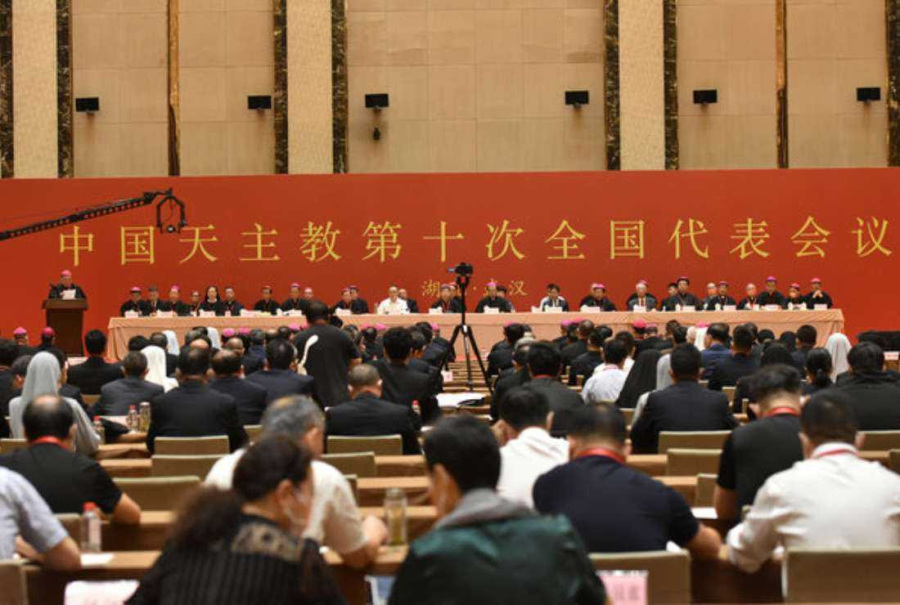
Participants attend the 10th National Congress on Catholicism in China in Wuhan on Aug. 18-20. (Photo: BCCCC)

Two state-sponsored Church bodies in China have elected new leaders during a five-yearly national conference who promised to invigorate the Catholic faithful pastorally in line with the socialist principles of the Chinese Communist Party (CCP).
The three-day 10th National Congress of Catholicism in China ended in Wuhan, the capital of Hebei province in central China, on Aug. 20. Senior officials from the CCP also attended the gathering and delivered speeches.
The meeting attended by some 345 Catholic bishops, clergy, and religious from across China ended with the election of new leaders of the Chinese Catholic Patriotic Association (CCPA) and the Bishops’ Conference of the Catholic Church in China (BCCCC), says a report on the BCCCC website.
Archbishop Joseph Li Shan of Beijing was elected chairman of the CCPA and Bishop Joseph Shen Bin of Haimen was voted in as the new BCCCC chairman.
The delegates also unanimously accepted the Work Report of the 9th Standing Committee on Church efforts and activities in the promotion of patriotism, socialism, and sinicization in the Catholic Church as outlined by President Xi Jinping.
The new leaders have issued a statement to commit themselves to engaging priests, religious, and laypeople including elders across the country for pastoral evangelization and further promotion of sinicization for “truth, pragmatism and inspiration” to move ahead toward a “bright future.”
"It is important to adhere to the direction of sinicization of Catholicism in China"
Sinicization is a profoundly political ideology that aims to impose strict rules on societies and institutions based on the core values of socialism, autonomy, and supporting the leadership of the CCP.
The statement also highlighted the need for the Catholic Church to implement the spirit of the National Conference on Religious Affairs held last December, and fulfill the requirement of the CCP Central Committee for the Catholic Church in China.
During that conference on Dec. 3-4, Xi stressed the strict implementation of Marxist policies, increased online surveillance, and tightening control of religion to ensure national security.
“It is necessary to unite and lead the priests, elders and faithful to follow Xi Jinping’s thought on socialism with Chinese Characteristics for a ‘New Era,’ continue to hold high patriotism and love for religion, adhere to the principles of independent and self-run churches,” the bishops’ statement said.
The Church leaders said they find it is important to adhere to the direction of sinicization of Catholicism in China to “vigorously strengthen the building of patriotic forces” to realize “the dream of the great rejuvenation of the Chinese nation.”
Following the communist takeover in 1949, China severed diplomatic ties with the Vatican.
The communist government formed the CCPA in 1957 to assert control over the Catholic Church. Many Catholics refused to join the state-controlled body and continued to pledge allegiance to the pope and the universal Church.
China has about 12 million Catholics split between patriotic and underground churches, independent researchers say.
For years, the appointment of bishops remained a bone of contention between the CCP and the Vatican with Beijing appointing and consecrating bishops without a Vatican mandate.
In 2018, the Vatican signed a provisional agreement with China for two years over the appointment of bishops, which was renewed for another two years in 2020. The provisions of the agreement have not been made public.
The Vatican reportedly seeks to unite Catholics divided between two churches with the deal, while it gives the Vatican a say to accept or veto bishops selected by Beijing.
Since 2018, six bishops have been ordained with approval from both China and the Vatican. Pope Francis has also recognized seven “illicit bishops” who were ordained without a papal mandate.
END
August Updates 2022
CATHOLIC CHURCH UPDATES
August 2022
8 Updates
1. State-backed Chinese Catholic gathering begins.
2. Devotion and gratitude of Chinese Catholics on the feast of the Assumption.
3. The parish of Xi Tang in Beijing on a synodal journey.
4. Chinese bishop pushing clergy into 'Patriotic Association'.
5. A summer of intense pastoral activity for the Catholic community, towards a newfound normality.
6. Holiness, witness of faith, vocation and mission: the themes of the annual retreat of the various dioceses.
7. Beijing Cathedral reopens after 6 months: 101 catechumens receive the sacraments of Christian initiation.
8. The retreat of priests and nuns from the diocese of Ningxia underlines the importance of spirituality.
1.
State-backed Chinese Catholic gathering begins
19th August 2022
UCA News - www.ucanews.com
10th National Congress of Catholicism in China plugs importance of sinicization, patriotism
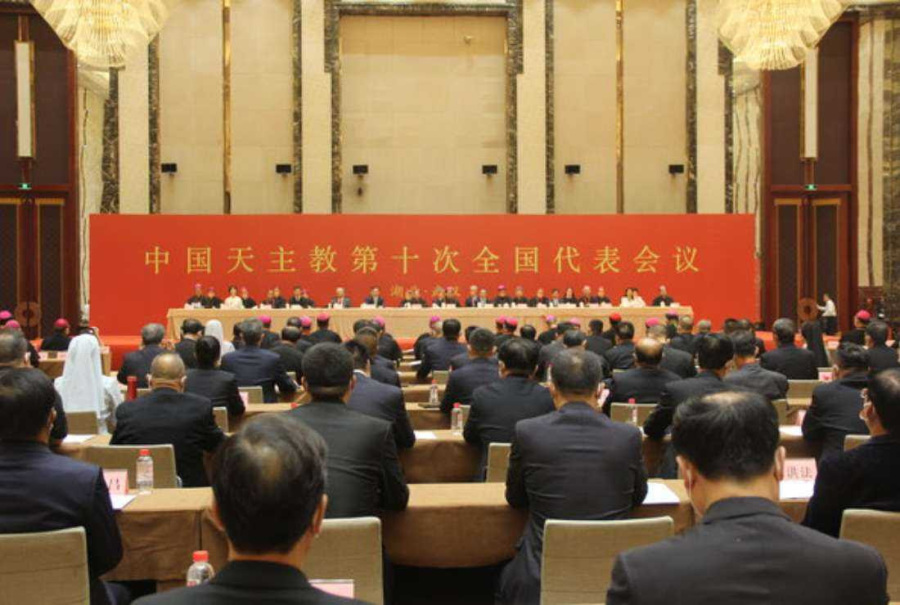
The 10th National Congress of Catholicism in China began in Wuhan, the capital of Hubei Province in central China on Aug. 18. (Photo: Bishops Conference of the Catholic Church in China)
Catholic bishops, priests and religious from across China have started a state-sponsored once-in-five years national conference in the presence of Chinese Communist Party (CCP) officials, stressing the importance of adhering to government policies on religious affairs and strengthening patriotism.
The 10th National Congress of Catholicism in China began in Wuhan, the capital of Hubei Province in central China on Aug. 18, says a notice on the website of the state-run Bishops Conference of the Catholic Church in China (BCCCC).
Some 345 Catholic bishops, priests, and religions representing 28 provinces, autonomous regions, and municipalities are attending the three-day assembly
Among the state officials attending are Cui Maohu, deputy minister of the United Front Work Department of the CCP Central Committee and Director of the State Administration of Religious Affairs, and Ning Yong, a member of the Standing Committee of the CCP Hubei Provincial Committee and Minister of the United Front Work Department.
Both Cui and Ning attended the opening ceremony and delivered speeches.
In his address, Cui said the government fully affirms various activities of the BCCCC and Chinese Catholic Patriotic Association (CCPA) over the past six years that highlighted commitments and love for the nation and allegiance to the party leadership.
He pointed out that since the 9th National Congress in 2016 in Beijing, Chinese Catholics have strengthened their ideological and political leadership, adhered to the road of independent and self-run churches, further promoted the construction of Chinese theological ideas, and focused on cultivating patriotism.
Cui said Chinese Catholics “love teaching and church talents, vigorously carry out social service undertakings, attach importance to strengthening self-construction, and have achieved remarkable results in various work.”
Archbishop Joseph Li Shan of Beijing, Bishop Joseph Shen Bin of Hamien, and Bishop Joseph Guo Jincai of Hebei delivered speeches during the opening ceremony of the conference.
Bishop Huang Bingzhang Huang of Shantou Diocese presented a report explaining the recent revision of the CCPA’s “One Council, One Mission” constitution to align with priorities set by President Xi Jinping
Deputy minister Cui emphasized that Chinese Catholics should “earnestly study” and implement Xi’s “important expositions on religious work” to adhere to the principle of independent and self-run churches, hold high patriotism and love for religion, and actively promote the process of sinicizing Catholicism in China.
Academically, sinicization of religion refers to the indigenization of religious faith, practice and ritual in Chinese culture and society, according to the Lausanne Movement.
However, the CCP advances sinicization as a profoundly political ideology that aims to impose strict rules on societies and institutions based on the core values of socialism, autonomy, and supporting the leadership of the CCP.
In his speech, Bishop Shen Bin said that the Chinese Catholic Church has always adhered to the correct political direction, led the majority of priests, elders, and faithful across the country to hold high patriotism and love for religion, and built a solid foundation for independent and self-run churches.
By promoting the sinicization of Catholicism in China, Bishop Shen said, the Church can carry out effective catechism, advance the cause of pastoral evangelization, actively participate in social welfare and charity, and write a “new chapter for the Chinese Church.”
Bishop Shen said that in the next five years, Chinese Catholics will fully implement the spirit of the National Conference on Religious Affairs held last December.
During that conference on Dec. 3-4, President Xi stressed the strict implementation of Marxist policies, increased online surveillance, and tightening control of religion to ensure national security.
Officially atheist Communist China recognizes the legal presence of five religions — Buddhism, Taoism, Islam, Catholicism, and Protestantism.
All religious groups are required to be registered with the government and strictly follow regulations set out for state-sanctioned organizations. Any violation of rules and policies triggers crackdowns, arrests, and the shuttering of religious groups and activities by the state.
China severed diplomatic ties with the Vatican following the communist takeover in 1949.
Following the first National Congress of Catholicism in China in 1957, the government formed the CCPA, to control the Catholic Church, while the underground Catholics continued to pledge allegiance to the pope and the universal Church.
Independent researchers noted that China has about 12 million Catholics split between patriotic and underground churches.
The 2018 Sino-Vatican Agreement was signed and renewed in 2020, to end the dispute between the Vatican and Beijing over the appointment of Catholic bishops.
____________________________________________________________________
2.
Devotion and gratitude of Chinese Catholics on the feast of the Assumption.
17th August 2022
Agenzia Fides - www.fides.org
ASIA/CHINA
Beijing (Agenzia Fides) - From Beijing to the vast
landscapes of Inner Mongolia, from the majestic Cathedral of the Redeemer in the capital to remote suburban communities, the Catholic communities of mainland China celebrated the Solemnity of the
Assumption with great devotion to the Mother of God. The prayer and the flower arrangement were a sign of filial love and special gratitude for supporting Our Lady in the life of faith of Christians
and in the mission of evangelization, especially in these difficult times of pandemics, war, hunger and poverty.
On the day of the Assumption, no fewer than five Holy
Masses were celebrated in the Cathedral of the Archdiocese of Beijing. "Let us work together in God's plan and grace, inspired by the example of the Blessed Virgin Mary," Archbishop Joseph Li Shan of
Beijing urged in his homily at the 9 a.m. Mass. The archbishop said in this context: "We must imitate the fidelity and humility of Our Lady in our daily life and always pray according to her
example".
In Jiangxi province, the persistent heat did not deter
believers, who went to church to celebrate their heavenly Mother with great joy and devotion. Many priests went to the local parishes to administer the sacraments to the faithful. After the solemn
Eucharistic celebration led by the parish priest, the parishioners of Fuzhou laid flowers in front of the statue of Our Lady to pray for a prosperous development and a rich life of the Church in
Jiangxi. The faithful also reaffirmed their desire to follow in the footsteps of Our Lady and to live the Christian life to the full.
Due to the pandemic, churches in Inner Mongolia only
reopened on the eve of the Solemnity of the Assumption. In the Dong Tang church, the parish priest, who is of Mongolian origin, urged everyone to "always trust in the intercession of the Blessed
Mother with a humble heart and to follow the Lord". Finally, all believers prayed for world peace, an end to the pandemic and the well-being of the people.
___________________________________________________________________
3.
The parish of Xi Tang in Beijing on a synodal journey
10th August 2022
Agenzia Fides - www.fides.org
ASIA/CHINA - The parish of Xi Tang in Beijing on a synodal journey towards the Solemnity of the Assumption of the Blessed Virgin
Mary
Beijing (Agenzia Fides) - In the framework of the "Year of
the Son of God", which will be celebrated in 2022, the parish of Xi Tang in the Archdiocese of Beijing, dedicated to the Blessed Virgin Mary of Mount Carmel, is preparing with the common prayer, the
Eucharistic adoration, intense spirituality and meditation to the forthcoming Feast of the Assumption. After reopening as a result of the easing of measures to combat the pandemic, the parish resumed
its activity on July 16, the Feast of Our Lady of Mount Carmel. In his homily, the parish priest Fr. Li Jianmin emphasized "the path of sanctification, purification and conversion" that every
believer has to walk and reminded the believers of the words of Mary from the Gospel. At the end, he presented all those present with the medal of Our Lady of Mount Carmel and recommended them to
"imitate Our Lady and her yes to God, to sanctify every day and serve their neighbor with missionary zeal". In the afternoon, the priest paid special attention to the elderly and sick and
administered the Sacrament of Anointing of the Sick to them.
On July 24, the parish, in communion with the universal
Church, celebrated the 2nd World Day of Grandparents and the Elderly, which is particularly in line with Chinese culture, which has deep respect, high regard and love for the elderly and
grandparents. After Sunday Mass on July 31, Fr. Li conducted a special catechesis course, during which he answered questions from parishioners to accompany them on their journey of faith. At the same
time officially opened a new catechesis course for adults.
Daily meditations on the Year of the Son of God offered on
the parish’s Wechat account. With such pastoral initiatives, the parish is continuing its synodal path with a view to the 300th anniversary of its founding, which is due in
2023.
With the gradual relaxation of the anti-Covid restriction,
the parish is ready to resume all its pastoral, missionary, charitable and cultural activities. The church choir will continue rehearsals for the Christmas concerts, 24-hour Eucharistic adoration
will resume, as well as fundraising for the “St. Francis Foundation” for the poor.
The parish of Tang in the Archdiocese of Beijing,
dedicated to the Blessed Virgin Mary of Mount Carmel, was founded in 1723 by the Italian missionary and great composer of Baroque music, Father Teodorico Pedrini (Fermo 1671 - Beijing 1746). To honor
the founder and musician, the church choir is named after the missionary. The congregation was the fourth church founded by Catholic missionaries in Beijing, after the congregations opened by
Portuguese and French Jesuit missionaries in 1650, 1665, and 1703.
__________________________________________________________________
4.
Chinese bishop pushing clergy into 'Patriotic Association
5th August 2022
UCA News - www.ucanews.com
Bishop Francis An Shuxin has threatened to withhold the Eucharist from clergy who fail to register with state-sanctioned CCPA
Bishop Francis An Shuxin of Baoding Diocese, China. (File photo)
Published: August 05, 2022 10:34 AM GMT
An international Christian group has condemned a Catholic bishop in China for threatening to withhold the Sacrament of Eucharist for clergy if they do not register with the state-sanctioned Chinese Catholic Patriotic Association (CCPA).
Bishop Francis An Shuxin of the Diocese of Baoding in Hebei province in northern China issued a pastoral letter July 15 stating that all Catholic clergy are required to register with the CCPA immediately or face punitive measures.
The prelate said he would not share the Eucharist with the priests who are not registered and warned local Catholics that if they refuse to accept priests who are registered with the CCPA they would face the same fate.
In a statement on Aug. 3, US-based International Christian Concern (ICC), said Bishop An’s letter was “a manipulation” of two major agreements signed between the Vatican and China.
Firstly, the Sino-Vatican Agreement of 2018 over the appointment of bishops in China, the ICC says.
The secretive deal was signed initially for two years and was renewed in 2020. It allows the CCP to have a say in the appointment of Catholic bishops in China, while the Vatican seeks to unify millions of Chinese Catholics split between state-run and Vatican-aligned churches.
Secondly, the Vatican issued a statement in 2019 that encouraged Catholics to register with the church, but warned against any attempt at forcible registration. It urged the Chinese government to respect the “conscientious objectors” to the Vatican-China deal who refuse to join the state-run church.
"At the same time, the Holy See understands and respects the choice of those who, in conscience, decide that they are unable to register under the current conditions," the Vatican said.
The ICC says Bishop An has manipulated the 2019 Vatican statement.
“In his letter, Bishop An manipulated the 2019 statement to make it seem as though the Vatican was commanding all clergy to register with the government in order to force the priests in his diocese to register,” the ICC said.
It reported that some clergy have resented the bishop’s letter exploiting the Vatican statement at the behest of the government.
Francis An Shuxin was consecrated by Bishop Peter Liu Guandong on May 2, 1993, as the Auxiliary Bishop of the Baoding diocese.
He was arrested in 1996 and was released after spending 10 years in prison as a member of the “underground” Church. He was appointed Coadjutor Bishop in 2007, when Bishop James Su Zhimin, the ordinary of the Diocese, was still in jail.
Bishop An Shuxin joined the government-sanctioned Chinese Catholic Patriotic Association, which split the diocese further between the underground and open communities. With the consent of the government, Bishop An was installed as the head of the Diocese of Baoding in 2010, leading the “Open” community.
He was installed as the Bishop of the Diocese of Baoding on August 7, 2010.
Communist China recognizes five religions – Buddhism, Taoism, Islam, Catholicism and Protestantism. However, it has extended state mechanisms to strictly monitor and control religious groups and their activities.
Shortly after the Communist takeover in 1949, China severed diplomatic ties with the Vatican and established the CCPA to exert control over Catholics in the country.
China has an estimated 12 million Catholics, divided between patriotic and independent churches. For years, China and the Vatican have been embroiled in pulling ropes over the appointment of bishops that apparently came to an end with the 2018 deal.
Since the signing of the deal, the Vatican appointed six new bishops and recognized seven ‘illicit’ bishops appointed earlier by China without papal mandates.
Rights groups have documented a renewed crackdown on Catholics in China since the CCP adopted the repressive new regulations of religious affairs in 2018, the same year the Sino-Vatican deal was inked.
____________________________________________________________________
5.
A summer of intense pastoral activity for the Catholic community, towards a newfound normality
3rd August 2022
Agenzia Fides - www.fides.org
ASIA/CHINA
Beijing (Agenzia Fides) - The restrictions against covid
in China are still in force but with less rigidity than in the past, as a result of the improvement in the health situation. Thus, the Catholic community throughout the country is experiencing a
summer of intense spiritual life and pastoral commitments, appreciating the normalcy that, at least in part, has been recovered, as can be seen in the doors of the churches that have finally
reopened. Information received by Agenzia Fides from all parts of China confirms the synodal harmony of the Chinese Catholic community even during this summer
period.
Great feast was held for two ethnic Tibetan deacons who
were ordained priests on July 18 at the parish dedicated to Our Lady in the diocese of Zhaotong. One of them is from the diocese of Dali, also in Yunnan province. Both will carry out their pastoral
service among the populations of minority ethnic groups, which are numerous in the region.
The Cathedral of the capital and several parishes have
celebrated, in communion with the universal Church, the Second World Day for Grandparents and the Elderly on Sunday, July 24. Great respect and high consideration for the elderly, like filial love
for grandparents, are part of Chinese culture, to the point that there was already a Day for the Elderly long before the one established by Pope Francis. In addition to the Holy Mass dedicated to
them, the Archbishop of Beijing, Msgr. Joseph Li Shan, and the parish priests of their communities also shared a moment of fraternity, celebrating the elderly with group photos and giving a small
symbolic gift but useful to them.
The Seminary of the Archdiocese of Beijing celebrated the
solemn Eucharist with the missionary mandate granted to the seminarians who have completed their studies and will be sent to the different parishes to carry out pastoral training. The Executive
Rector has urged everyone to observe the motto of the Seminary - "Glorify the Lord, benefit the soul and serve the people" - inviting them to "row out into the deep" to build the
Church.
Also in the archdiocese of Beijing, the cathedral
dedicated to the Most Holy Savior, the one in Nantang dedicated to the Immaculate Conception and the one in Xitang dedicated to Our Lady of Mount Carmel, as well as many other parishes, have begun
registration for the new catechetical course, which begins in August and will end next year.
Among the activities for young people, the parish of
Jiujiang, in the province of Jiangxi, held a training course for altar boys on July 17. Father Cao Xiaoxian explained to them the importance of their commitment as follows: "During the Holy Mass,
besides the priest, you are the closest to God. So you must prepare not only the various objects that are needed, but above all your soul, your spiritual welcome...".
___________________________________________________________________
6.
Holiness, witness of faith, vocation and mission: the themes of the annual retreat of the various dioceses
1st August 2022
Agenzia Fides - www.fides.org
ASIA/CHINA
Beijing (Agenzia Fides) - The journey towards holiness,
the communion of the diocesan community (between priests, with the Bishop and the faithful), the synodal journey, the witness of faith, the vocation and mission of evangelization: these are the main
themes of the annual spiritual retreat which took place in the various dioceses of mainland China during the month of July.
"Living according to the Christian spirit, practicing
holiness and bearing witness", is the invitation that Msgr. Joseph Wu Qinjing, Bishop of the diocese of Zhouzhi in the province of Shaanxi, addressed to the priests of the archdiocese of Hangzhou,
the capital of the province of Zhejiang. During the five days of meditations, from July, 25 to 29, Msgr. Wu, invited to preach the retreat, took the Apostle James as a model, especially his vocation
and his own life, to highlight the true meaning of being followers of Jesus. He also illustrated the value of the testimony of faith and the nobility of the sacrifice of service. "Living the
Christian spirit, practicing holiness and bearing witness" will be indispensable to promote the communion of the diocese, the synodal journey, the rebirth of vocations and above all to welcome the
abundant divine graces.
"Vocation and mission" was instead the theme of the
spiritual retreat that took place from July 11 to 13 in the diocese of Chengdu for the entire community of priests, seminarians and nuns in the province of Sichuan, of which Chengdu is the capital.
Under the guidance of Fr. Lu Zhijun, a priest of the Weinan diocese of Shaanxi province with a great experience of spirituality, the participants meditated together on their relationship with the
Lord, the vocation of Abraham, the evangelical episode of the Samaritan woman at the well, to respond to the Lord's call of love, carrying out the mission with poverty, patience and a spirit of
service. In his speech, Bishop Msgr. Joseph Tang Yuange encouraged all those present to promote the pastoral care and evangelization of the diocese with a new spiritual impetus, resulting from these
days of retreat and above all from the strong experience of communion.
___________________________________________________________________
7.
Beijing Cathedral reopens after 6 months: 101 catechumens receive the sacraments of Christian initiation.
18th July 2022
Agenzia Fides - www.fides.org
ASIA/CHINA
Beijing (Agenzia Fides) - The Catholic Community of the
Archdiocese of Beijing celebrates not only the reopening of the church after six months of closure due to government anti-Covid regulations, but also the sacraments of Christian initiation of 101
catechumens, mostly adults.
Before dawn on July 16, the day of reopening, the
faithful, both young and old, were waiting outside the gate, rejoicing at being able to resume their spiritual, liturgical and pastoral activities in the presence of their beloved community. The
first stop, as always, was prayer in front of the Grotto of Our Lady of Lourdes and finally in front of the altar to give thanks to the Lord for this moment.
The Cathedral complex, with the church, the courtyard and
the sacristy were again filled with prayers, spiritual songs, smiles and even the "noise" of the children. At five o'clock in the afternoon of July 16, the participants in the catechism course were
baptized and received the other sacraments of Christian initiation, Confirmation and First Communion, from Archbishop Joseph Li Shan of Beijing.
The emotion and joy was seen on their faces and those of
the community, but also on those of the catechists, priests, nuns and lay catechists who accompanied them on their journey of faith during the pandemic. Referring to Psalm 126 "Those who sow with
tears will reap with songs of joy. Those who go out weeping, carrying seed to sow, will return with songs of joy, carrying sheaves with them" (cf. 126, 6), Msgr. Li encouraged those present to keep
this wonderful experience.
"Through baptism you are children of light, through
confirmation you are sent by Christ". And "baptism is not a mere ritual, but an interior conversion. Live an authentic life of faith now, put on a new spirit and a new identity, which is Christian
... you shall be the light of the world and the salt of the earth, incarnating Christ and bearing witness to our Lord with love and works".
The parish priest of the Cathedral, Fr. Joseph Zhao,
thanked all those who had followed the long journey of faith and asked everyone to continue to protect these "new seedlings" of the community so that they can grow together in the Church on the path
of synodality. With the reopening, the Cathedral resumed its normal liturgical and pastoral activities.
___________________________________________________________________
8.
The retreat of priests and nuns from the diocese of Ningxia underlines the importance of spirituality
6th July 2022
Agenzia Fides - www.fides.org
ASIA/CHINA - "Open your heart to welcome the Lord": the retreat of priests and nuns from the diocese of Ningxia underlines the
importance of spirituality
Ningxia (Agenzia Fides) - Open your heart, close your
mouth, meditate in silence, make an examination of conscience to welcome the Lord during prayer, a face-to-face meeting with the Lord to be able to hear his voice and respond to his
call.
These are the characteristics of the annual spiritual
retreat of the diocese of Ningxia (Yinchuan), in mainland China, which took place from June 25 to 28. According to reports from Faith, the most authoritative Chinese Catholic bulletin in print and
online, 37 priests, seminarians and nuns from the diocese took part in the retreat on the importance of spirituality.
The four effects of spirituality were explained in depth
through the Bible, psychology, spirituality: it gives meaning to pastoral and missionary activity; helps find answers to life's questions; it can renew the mission; facilitates interaction with God.
Msgr. Joseph Li Jing, Bishop of the diocese, joined the priests, nuns and seminarians to encourage the synodal journey after the spiritual retreat, so that they transform their pastoral, social and
missionary work with a new spiritual impulse.
The diocese of Ningxia is very active in the social
sphere, bringing the magisterium of the Church into concrete service. Thus, following the invitation to protect the environment, as Pope Francis teaches in his Encyclical Laudato Sì on the care of
the common home, the diocesan social service center often organizes various initiatives related to the theme. These include the production of vegetables free of pollutants, the propaganda of separate
collection of waste and the campaign for a plastic free world, the banning of plastic in order to protect the environment and practice the concept of green development, which has also been relaunched
by the government.
In addition, Msgr. Li personally guides the march of
Catholics on World Environment Day on June 5. The diocese also gave the utmost importance to the formation of priests, nuns, catechists, pastoral workers, Catholic volunteers and social workers, so
that they can make Catholic witness alive in every area of life.
The diocese of Ningxia was born with the arrival of the
Missionaries of Scheut (Congregation of the Immaculate Heart of Mary, CICM). In 1879, Fr. Van Sante Karel and Fr. Bermyn Aifons CICM, brought the Gospel to the Ningxia region, where the Muslim
population of the Hui ethnic group lives. In 1922 the Apostolic Vicariate of Ningxia was created, with Msgr. Godefroy Frederix as the first Bishop. It was then erected a diocese in 1946, the year of
the establishment of the Church hierarchy in China. This diocese boasts Msgr. Joseph Ma Zhongmu (1 November 1919 - 25 March 2020) as its bishop, who recently passed away at the age of 101. Msgr. Ma
was the only bishop of Mongolian ethnicity. Among the innumerable merits of this great Pastor is the translation of the Roman Missal and the Gospel into the Mongolian
language.
END
July Updates 2022
CATHOLIC CHURCH UPDATES
July 2022
8 Updates
1. Seminarians and nuns conclude their studies: new missionary resources for evangelization in China.
2. Bishop Pietro Wu Junwei dies of a heart attack.
3. Youngest cardinal from Mongolia has vital role to play.
4. Singapore Catholics welcome prelate's elevation to cardinal.
5. The Year of the Amoris lætitia Family in the diocese of Macao: many initiatives in the wake of the synodal path.
6. Arrest of Hong Kong cardinal problematic for the Vatican.
7. China's first indigenous female religious congregation celebrates 150 years.
8. Why the Church wants to be present in China?
1.
Seminarians and nuns conclude their studies: new missionary resources for evangelization in China.
24th June 2022
Agenzia Fides - www.fides.org
Beijing (Agenzia Fides) - "You must have the missionary
fire of the Apostle Paul to attract more people to the Gospel so that they can obtain salvation. You must have a humble and simple attitude, reaching out to the poor and disadvantaged so that they
feel the strength of the Love of Christ and convert to Christ": these are the recommendations of Monsignor Antonio Dang Mingyan, Archbishop of Xian, addressed to the 3 seminarians who have obtained
the Baccalaureate and to the 15 nuns who have received the Diploma at the end of their cycle of studies, during the Eucharist that he celebrated for this occasion in the Major Seminary of the
province of Shaanxi.
Msgr. Antonio Dang Mingyan, Archbishop of the provincial
capital and Rector of the Seminary, presided over the solemn Eucharistic together with 9 professors who accompanied the young people on their vocational path. The Vice Rector, Fr. Li Jingxi, has
expressed his sincere wishes to the graduates so that "they truly respond to the call of the Lord, take on pastoral duties, become shepherds of Jesus Christ and dedicate their lives to the pastoral
evangelization of the Church" in China and in the world.
In fact, the Church in Mainland China is experiencing a
harvest season, a harvest of vocations, of mission, of evangelization. The new graduates are the new resources, the new blood and the new workers for the vineyard of the Lord in China. After six
years of diligent theological, philosophical and above all spiritual and human formation, they are ready to venture into the immense pastoral field that awaits them, to preach, to serve the Church
and the people of God, to face contemporary missionary challenges.
According to information gathered by Agenzia Fides, in a
solemn ceremony held on June 18, 23 seminarians from the National Seminary of the Catholic Church in China received the Baccalaureate degree after 6 years of theological and philosophical studies.
Now they continue their vocational journey through the pastoral path in various parts of China, according to their origin. (NZ)
__________________________________________________________________________________________________________________________________________________
2.
Bishop Pietro Wu Junwei dies of a heart attack.
6th June 2022
Agenzia Fides - www.fides.org
ASIA/CHINA - Bishop Pietro Wu Junwei dies of a heart attack. During the pandemic he had worked to keep churches and activities
open
Xinjiang (Agenzia Fides) - At 10.30 a.m. on May 10, 2022,
His Exc. Msgr. Peter Wu Junwei, Bishop of the Apostolic Prefecture of Xinjiang/Yuncheng, in the Chinese region of Shanxi, died of an acute myocardial infarction at the age of
59.
The Prelate was born on June 27, 1963 into a family of
devout Catholics in the town of Xiliulin, Taiyuan. He was the eldest of six children, of whom a brother became a priest and a religious sister. In 1985, he entered the Shanxi Major Seminary and was
ordained a priest on December 9, 1990.
From 1991 to 1996, Monsignor Wu was a parish priest in
Shagou and also carried out the pastoral care of Loufan and Gujiao; from 1996 to 2001 he was diocesan director for ecclesiastical affairs and head of the propaedeutic Seminary of the Archdiocese of
Taiyuan, as well as deputy parish priest of the cathedral and diocesan treasurer; from 2001 to 2009 he was rector of the Shanxi Seminary and from 2009, responsible for the Diocese of
Xinjiang/Yuncheng. On September 21, 2010, he was consecrated Bishop and appointed Apostolic Prefect of Xinjiang/Yuncheng.
From the beginning of his mandate, he dedicated himself to
evangelization, promoting catechetical courses for the faithful and the construction of new churches and developing the Apostolic Prefecture according to its particular needs. Lately, during the
pandemic, he had worked even harder to keep churches and various community activities open. All this caused him great fatigue, which led him to suffer from some illnesses and unfortunately to
death.
From May 10, the Bishop's body was exposed to the faithful
in the Cathedral of Xinjiang, where his funeral was held on May 16, followed by his burial in the diocesan cemetery of Duanjiazhuang. Msgr. Wu is remembered by the Catholic faithful as a simple,
humble Pastor, faithful to the Lord and to the Church, totally dedicated to the episcopal ministry and to the people entrusted to him.
Currently, in the aforementioned Apostolic Prefecture
there are 28 priests and 15,000 faithful, a diocesan congregation of about 40 nuns, 18 churches, 11 places of worship and some social works.
___________________________________________________________________
3.
Youngest cardinal from Mongolia has vital role to play.
3rd June 2022
UCA News - www.ucanews.com
Bishop Giorgio Marengo has roots in Italy and is expected to link Europe and Asia in more ways than one.
Bishop Giorgio Marengo of Ulaanbaatar is to become the youngest cardinal. (Photo: wikipedia.org)

Making someone a prince of the Catholic Church in a sparsely populated Asian country sandwiched between communist China and authoritarian Russia has much to do with faith and pastoral requirements. But its apparent geopolitical expediency cannot be ignored.
By conferring a red hat on 47-year-old Bishop Giorgio Marengo, the apostolic prefect of Ulaanbaatar in Mongolia, 85-year-old Pope Francis has found his youngest cardinal.
Bishop Marengo came to serve Mongolia in 2002, hardly two years after his ordination as a priest. Church records show it is a tiny mission with fewer than 1,300 Catholics in a population of 3.5 million, served by two Mongol priests, 22 foreign missionaries and 35 nuns.
The newest and the first cardinal-elect from the East Asian nation will be eligible to vote in papal conclaves for 33 years. There is a widespread perception among Vatican watchers that this will be Pope Francis’ last addition to the College of Cardinals and, therefore, he wants to put things in a correct perspective.
The pope has started paying attention to the small communities of faithful scattered throughout the world, Italy-born Bishop Marengo said soon after the pope made the announcement of his elevation in St. Peter's Square.
“… I believe that the pope's gesture was a missionary gesture, to express attention and care to a small community and to all the small communities of faithful scattered throughout the world, in those lands where they are a small flock,” he said.
Mongolia shares a 4,630-kilometer border with China and shares many cultural aspects with the communist nation’s people. China houses more Mongol people than Mongolia itself
He was referring to the scarce population of Catholics in the difficult terrain of Mongolia, and Catholics in neighboring China and Russia, which have locked horns with the US, the European Union and NATO.
Mongolia may be a democracy but the landlocked Buddhist-majority nation is already a key commodity transit point for the two autocratic regimes.
In the Ukraine conflict, Mongolia, a former Soviet satellite nation until 1990 and dependent on China as a market and conduit for its copper and coal exports, has stayed neutral by refusing to join the US-led NATO coalition against Russia.
Four days after the Russian invasion of Ukraine on Feb. 24, Mongolia signed a memorandum of understanding on the long-planned trans-Mongolian gas pipeline deal that will supply Mongolia with gas from Siberia’s Yamal fields and will allow Russia to transport gas to China.
The EU gets 40 percent of its energy from Russia and is reducing its dependence on it. Mongolia is playing a vital role in finding markets for energy from Russia, which is facing US-led international sanctions.
If the Ukraine conflict is prolonged or if China and Russia form an anti-Western alliance, Mongolia’s political orientation may change once and for all.
That does not mean that the West is deserting Mongolia, three times the size of France with half its population in capital Ulaanbaatar. In May, the UK's Asia minister of state, Amanda Milling, visited the country to coax it along with the Western discourse.
Mongolia shares a 4,630-kilometer border with China and shares many cultural aspects with the communist nation’s people. China houses more Mongol people than Mongolia itself.
“Dialogue with the Buddhist world, which is a majority in Mongolia, is fundamental for us. It is part of our mission. I am sure it will bear good fruit"
Though the Vatican has inked a secret pact with China on the appointment of bishops, the 2018 deal is believed to have clauses against the Holy See conferring the red hat on prelates living in China.
The Vatican has selected the Catholic leader of Mongolia, which has anthropological ties with China, as its man in the region. In the case of a standoff between China and the West, the Vatican can use the youngest cardinal from Mongolia, a nation that stretches between imposing mountain ranges in the north and arid expanses in the south, as a go-getter.
The appointment also comes as Mongolia observes the 30th anniversary of the rebirth of the Church and the establishment of diplomatic ties with the Holy See. The Church in Mongolia is part of the newly formed Bishops' Conference of Central Asia.
“Dialogue with the Buddhist world, which is a majority in Mongolia, is fundamental for us. It is part of our mission. I am sure it will bear good fruit," Bishop Marengo said while leading a Buddhist delegation to Rome at the time of his appointment.
Asia already has 15 cardinal electors. The new consistory will increase Asian representation significantly to 21 with six new cardinals from Asia. Though Africa also had 15 cardinal electors, only two prelates got the red hat this time. In that sense, the pope has put Asia ahead of Africa.
Already the Papa Rosso, or the Red Pope, is from Asia in 64-year-old Cardinal Luis Tagle from the Philippines. His position as head of the Vatican Congregation for the Evangelization of Peoples is second only to the pope.
Cardinal Tagle was last week given the additional charge of heading another important Vatican office — the Congregation for Divine Worship and the Discipline of the Sacraments.
The selection of Bishop Marengo, who has roots in Italy, is a clear sign that the young cardinal is expected to play a vital role in linking the Church in Europe and Asia in more ways than one.
* The views expressed in this article are those of the author and do not necessarily reflect the official editorial position of UCA News.
___________________________________________________________________
4.
Singapore Catholics welcome prelate's elevation to cardinal.
30th May 2022
UCA News - www.ucanews.com
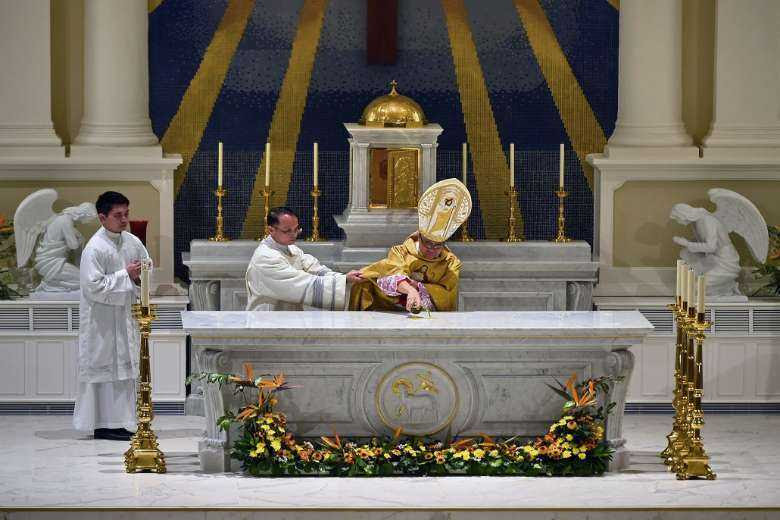
Archbishop William Goh performs the Rite of Dedication marking the 120th anniversary of the Cathedral of the Good Shepherd in Singapore on Feb. 14, 2017. (Photo: AFP)
Published: May 30, 2022 08:26 AM GMT
Pope Francis has nominated Archbishop William Goh of Singapore among 21 new cardinals to be appointed in August in a move which the archdiocese said shows the global Church’s recognition of the missionary Church in the multicultural city-state.
“Archbishop William is conscious that this honor and new responsibility conferred on him is also a recognition of the contribution of the faithful in the archdiocese for helping him to build a vibrant, evangelizing and missionary Church,” the archdiocese said.
Archbishop Goh, 64, heads the Catholic community of some 300,000 in the city of 5.6 million which includes Christians, Buddhists, Taoists, Muslims and Hindus, besides some 18 percent who follows no religion.
Christians increased from 12.7 of the population in 1990 to 19 percent in 2015, census records show. Singapore’s Catholics, mostly Chinese and Indian migrants and their descendants, have increased to 5.35 percent now from 4 percent in 1990.
In his latest appointments, Pope Francis showed his pattern of bypassing major cities and traditionally considered cardinal seats, preferring to appoint bishops who are leading small or growing churches.
Five other cardinals in Asia come from Goa and Hyderabad in India, Dili in East Timor and Ulaanbaatar in Mongolia. The fifth one from South Korea works in a Vatican curia.
Archbishop Goh’s appointment “calls for him to serve not just the Archdiocese of Singapore; he will be expected to assist the Holy Father in the task of governing the universal Church,” the archdiocesan communication office said in a statement.
The prelate “is deeply humbled by this new appointment” and seeks the prayers of all so that “he can assume this responsibility with humility, wisdom and holiness,” the statement said.
Archbishop Goh was ordained a priest in the archdiocese in 1985 and was made archbishop in May 2013. He took over from Archbishop Nicholas Chia, who led the archdiocese from 2001 to 2013.
___________________________________________________________________
5.
The Year of the Amoris lætitia Family in the diocese of Macao: many initiatives in the wake of the synodal path.
19th May 2022
Agenzia Fides - www.fides.org
Macao (Agenzia Fides) - Within the framework of the year
of action for marriage and family proclaimed by Pope Francis, “Year of the Family – Amoris Letitia”, the Catholic Church in Macau has launched numerous initiatives, including the charity sale of face
masks, family workshops, the basketball competition with teams of parents and children, a study seminar on the history of the Church in Macao. On April 24th, the sale of masks was intended to raise
funds for various projects to bring the diocese together as a family in the spirit of charity. Previously, the March 26 family gathering aimed to illustrate family ties in the spirit of “Amoris
lætitia” through a photo exhibition. The meeting ended with a solemn joint thanksgiving.
At the opening of the campaign year, Fr. Stephen Lee made
it a priority to bring the figure of St. Joseph and his role in the Holy Family closer to the faithful. After more than 400 years of evangelization history, the Diocese of Macau today has a total of
nine parishes, 32 ecclesiastical educational institutions and around 50 charitable organizations. In the footsteps of the missionaries, including Jesuits, Franciscans, Augustinians, Dominicans, more
than 30,000 faithful are active in society today, supported by 21 priests and about 200 religious. (NZ)
_________________________________________________________________________________________________________________________________________________
6.
Arrest of Hong Kong cardinal problematic for the Vatican.
12th May 2022
UCA News - www.ucanews.com
Outspoken Cardinal Joseph Zen has been critical of certain people close to the pope
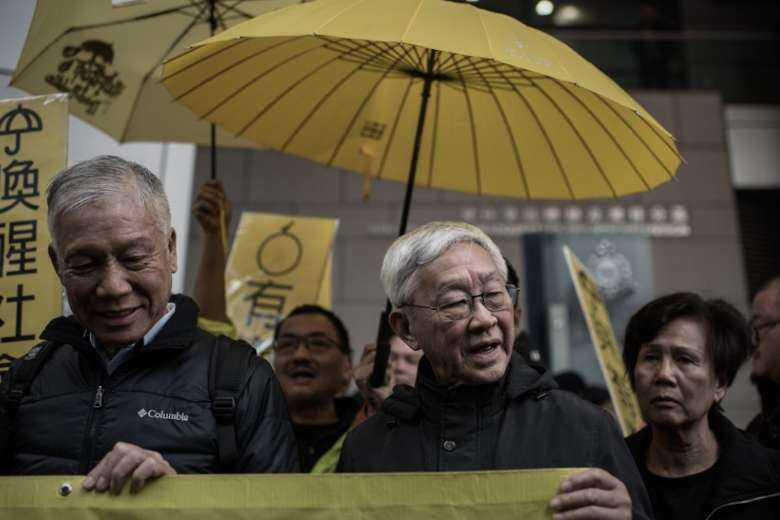
Cardinal Joseph Zen joins pro-democracy activists in front of Wanchai Police Station in Hong Kong on Jan. 24, 2015. He has long been a thorn in the side of Beijing. (Photo: AFP)
The arrest of Hong Kong's bishop emeritus, Cardinal Joseph Zen, 90, hardly comes as a surprise. He has been a thorn in the side of authorities in both Hong Kong and Beijing for decades and as Chinese leader Xi Jinping has tightened his grip on the city, he was surely on the list of high-profile agitators to be shut down.
Cardinal Zen, who is now on bail, has long been an advocate of democracy and the independence of Hong Kong by virtue of the “one country, two systems” formula. He has been a leading senior figure in protests in the city for many years. His criticism of the ruling Chinese Communist Party (CCP) has been as consistent as it has been harsh since he fled his native Shanghai for Hong Kong in the 1940s.
He was bishop of Hong Kong from 2002 to 2009 and was elevated to the College of Cardinals in 2006 by Pope Benedict XVI. During the so-called Umbrella Movement in 2014, he slept on the streets with student protesters. Older and frailer by the time protests amped up again in 2019, he was still in attendance and a constant presence on social media.
It must be said that he drove his successor Cardinal John Tong — who was forced to step back into the top job after his successor Michael Leung died in early 2020 — to distraction.
Cardinal Zen was arrested under Hong Kong’s tough national security law designed to bring people opposed to the CCP into line as Beijing continues its project to draw Hong Kong more completely into the People’s Republic.
Specifically, his arrest relates to his role as a trustee of the 612 Humanitarian Relief Fund. This was set up to offer financial assistance to those involved in anti-government protests in 2019. It was disbanded last year after authorities ordered it to share operational details. Four other trustees were also arrested. One is already in jail for other offenses under the security law.
Cardinal Zen’s primary concern is that the deal will kill the unofficial or underground church in China that comprises as many as half of China’s estimated 12 million Catholics
Cardinal Zen’s arrest came just two days after the appointment of John Lee as the Special Autonomous Region’s new chief executive. Lee, who will officially take office in June, was the former security minister and one of the key figures in the creation of the proposed extradition bill in 2019 that would have sent Hong Kong suspects to mainland China, where courts operate under the ruling CCP instead of the common law.
When Beijing imposed its sweeping national security law on Hong Kong in 2020, Lee was seen as its main facilitator and enforcer.
While Cardinal Zen’s support of protesters and agitation for democracy made him unpopular with Hong Kong authorities, the wider concern in Beijing has been his ongoing critique of the Vatican’s controversial and still secret 2018 deal with Beijing regarding the appointment of bishops.
Renewed in 2020, it was Rome’s attempt to restart a difficult relationship with the CCP that has seen waves of persecution of mainland Catholics over decades as well as a personal project of Pope Francis, who set Asia and China as a focus of his pontificate.
At that time, Beijing seized control of much of the Church, setting up the Chinese Patriotic Catholic Association (CPCA) as part of the party's apparatus.
Cardinal Zen’s primary concern is that the deal will kill the unofficial or underground church in China that comprises as many as half of China’s estimated 12 million Catholics. The underground church has fealty only to Rome and refused to recognize the state-run CPCA.
Cardinal Zen has always insisted that Beijing cannot be trusted and he sees the proof in the CCP’s long history of arresting and jailing priests and bishops, with a number still unaccounted for in recent decades
His contempt for the deal has not only been reserved only for Beijing but for Rome as well. In particular, he has targeted Vatican Secretary of State Cardinal Pietro Parolin, who “is the one who has his hands on the Chinese dossier. He clearly believes that such a position is necessary to open a new way for the evangelization of the immense Chinese nation. I have strong doubts.” He believes that Pope Francis has been duped by his chief lieutenant.
Cardinal Zen has always insisted that Beijing cannot be trusted and he sees the proof in the CCP’s long history of arresting and jailing priests and bishops, with a number still unaccounted for in recent decades. His fears of an attack on the unofficial church were borne out in recent years with the arrests of more than a dozen priests and bishops.
Cardinal Zen’s arrest is problematic for the Vatican in a number of ways. Its deal with Beijing is up for its two-year renewal by September and this will surely cloud any talks already underway. While Rome, too, will be unsurprised by his arrest, any moves to advance the case and perhaps put the nonagenarian in jail will only give Pope Francis’ increasingly noisy critics more ammunition.
Beijing/Hong Kong should also tread carefully as Cardinal Zen has become a symbol of religious opposition to the Chinese party-state. His arrest and potential incarceration will remind people of the communist parties in Eastern Europe who jailed church leaders such as Poland's Cardinal Stefan Wyszynski, creating heroes for many Catholics.
Persecuting religious heroes, or if they die while under investigation or jailed, creates martyrs, symbols to rally opposition. And this is true as much for the CCP as for Pope Francis and his allies in the Vatican.
* The views expressed in this article are those of the author and do not necessarily reflect the official editorial position of UCA News.
________________________________________________________________
7.
China's first indigenous female religious congregation celebrates 150 years.
2nd May 2022
Agenzia Fides - www.fides.org
ASIA/CHINA - Deepening and living the charism on the synodal journey:
China's first indigenous female religious congregation celebrates 150 years
Beijing (Agenzia Fides) - Retracing history, deepening and
reviving the charism of the founder by embarking on the synodal path: these are the objectives of the celebration of the 150th anniversary of the founding of the first indigenous female religious
congregation in China, the Religious Congregation of St. Joseph of the Archdiocese of Beijing. Following in the footsteps of their founder, Msgr. Louis-Gabriel Delaplace, CM, then Archbishop of
Beijing, since 1872 the sisters have continued their intense pastoral and missionary commitment, living community life, despite the pandemic and its consequences on the life of the Church. In fact,
the sisters renewed their religious vows with the only virtual participation of friends and relatives.
The lay faithful have always been their first apostolic
commitment, which is why they periodically promote an "Opening Day" to welcome lay people and also non-Christians. They live this occasion in four moments: presentation of the history and life of the
congregation; guided visit; seminar or simple exchange meeting; prayer in the chapel. Each time they can accommodate more than a hundred people, not only Christians. In some circumstances they also
invite the sisters studying at the national seminary in Beijing, who come from all over the country, to share their vocation and experience of community life. After 30 years of closure caused by the
cultural revolution, the Beijing diocesan religious congregation dedicated to Saint Joseph reopened in 1986, with six young people from the suburbs of Beijing. Today the congregation celebrates 150
years of foundation with great achievements in the pastoral and evangelization field.
Currently the 49 nuns work in various dioceses, parishes,
schools, clinics and in a nursing home. Candidates must possess the religious, cultural, psychological and moral aptitudes necessary to follow the high standards of community life. For their
formation, courses are offered in Sacred Scripture, catechism, Church history, fundamental theology, canon law, liturgy, spirituality, philosophy and sacred music. There are also courses in physics,
Chinese literature, Chinese moral tradition, social science, and foreign language. The motto of the congregation is taken from 1 Cor 9,19 ("I have become a servant of all to win the greatest number")
and from Luke 17,10 ("When you have done everything that you have been commanded, say: We are useless servants. We have done what we had to do").
The Congregation was founded by Msgr. Louis-Gabriel
Delaplace, CM, Bishop of Beijing, in 1872. According to historical sources, during a time of meditation and prayer, Bishop Delaplace was inspired by Saint Joseph to found a Chinese religious
congregation. The proposal was discussed at the Vatican Council of 1870. After two years of preparation, with the help of the Canossian Sisters, the Congregation of Saint Joseph was founded in
Beijing in 1872, whose nuns came exclusively from Beijing and its surroundings. Today there are nuns from various Chinese provinces. According to the founder, the main purpose of the Congregation is
service (ecclesial and social) and mission. In 1941 the Congregation reformed its structure, changed its statutes and its religious habit, and added the profession of the vow of poverty (before the
religious professed only the vows of obedience and chastity). The date of religious profession has always been linked to the feast of Saint Joseph. The activity of the sisters is carried out mainly
in the fields of health and education, but they are always available for the requests and needs of the diocese. (NZ)
___________________________________________________________________
8.
Why the Church wants to be present in China?
Why the Church wants
to be present in China
Synopsis and full text of the address of the Jesuit SG
The Church and the Society of Jesus have sought, are seeking and will continue to seek to
inculturate themselves in the complex and changing social reality of the immense nation that
is China.
The activity of the Church in China, including the
participation of the Holy See at various levels, is to be understood as pastoral and takes
into account the details proper to current social relations within China and its political
context.
Chinese Catholics keep their roots deeply immersed in
their culture and express their faith in ways that their culture offers to symbolize what they
are and what they experience.
To write the future of
the Church in China we need to start with the question: How and where does the
action of the Holy Spirit manifest itself in Chinese society today?
Th full text of Fr. Arturo Sosa Sj can be read below.. This was one of a collection of essays on the Church in China delivered at a conference in Rome earlier this year. The theme was the Church in China: A future to be written.
______________________________
Inculturation: following the kenotic
incarnation of Jesus
In his Message to Chinese Catholics and the
Universal Church, of September 26, 2018, Pope Francis wrote:
“For my part, I have always looked upon China as a land of
great opportunities and the Chinese people as the creators and guardians of an inestimable patrimony of culture and wisdom, refined by resisting adversity and embracing diversity.”[2]
This was my interpretive key as I read the book La Chiesa in Cina. Un futuro da scrivere published by Fr. Antonio Spadaro. The only purpose of my talk today is to share my reflections on reading the book. The authors of the chapters in this volume have each written from their own perspectives and experiences, and the reader is drawn into a
dialogue, bringing his or her own set of sensibilities and existential or intellectual points
of view. It is a dialogue that touches on some aspects of the vast and complex reality
of the Church in China.
The reflections I share do not represent the official
position of the Society of Jesus in relation to the issues dealt
with in the book, nor to the political situation of the Church
in China. I myself have no direct experience of
China; however, I belong to the Church present in China and to
a body – the Society of Jesus – that has had, and continues to have, many relations with China.
The fact that the Church wants to be present in China responds to the Lord’s invitation to go to all the peoples of the world, to be in all the corners of the earth, to invite people to transform their lives, to make them more human according to the model that we have received in Him.
A look at the current world tells us that, if we do
not reckon with everything that China represents, it is not possible
to make progress in reconciliation between the peoples of the world. Nor will it be possible, without the conscious and active participation of the Chinese people, to arrive at a sustainable ecological balance for the planet or to achieve the United Nations’ goals of overcoming poverty and
securing human development.
The Church and the Society of Jesus have sought,
are seeking and will continue to seek to inculturate
themselves in the complex and changing social reality of the
immense nation that is China. This is an inculturation inspired by
the incarnation of Jesus, who made himself present in human history in the midst of a reality of poverty and social, religious and political oppression. Inculturation, according to the style of Jesus, is a kenotic journey, that is, its point of departure is to untie oneself, to draw back from every position of privilege and power, to become “one of many”
(cf. Phil 2:6-8).
For the Church to be inculturated in the reality of
China implies her abandoning every claim to wisdom or social recognition in order to move to the new reality in which she desires to live fully. Inculturation involves leaving one’s own home to go and live in the house of another, and so learn to live in a house other than the one you are used to.
Inculturation is an open and sincere encounter in
which everyone puts themselves into play. Christianity has something very valuable to offer to every human culture, at each moment of history. Our treasure is the person of Jesus Christ, who revealed to us the merciful face of God and opened the way for fraternity, through which we recognize ourselves as human beings, brothers and sisters,
responsible for the common home, where we can live in peace if, guided by the Spirit, we
pursue social
justice. The encounter that comes from the effort of inculturation takes place only if it is aroused by the love that God has poured into the heart of every human being
and is reflected in many ways in the different cultural expressions of each people.
Since Christianity is
not a culture but a religious faith capable of incarnating itself in every human culture, it
does not compete with the cultures it meets and encounters. On the contrary, it offers each of them a new opportunity to go deeper into the knowledge of their own roots and to open up to the universal reality of full humanity.
For this reason inculturation makes possible the existence of “Chinese Catholicism,” which is, at the same time, universal Catholicism. Chinese Catholics keep their roots
deeply immersed in their culture and express their faith in ways that their culture offers to symbolize what they are and what they experience. At the same time, inspired by the Spirit of Jesus, Chinese Catholics participate in the universal body of the Church, which seeks to contribute to the process of reconciling all things in Christ.
“Sinicizing” Christianity is not easy. It is a complex
process and always incomplete. It is as complex as the Chinese cultural reality, with its immense variety and breadth of traditions. It is incomplete, because no living culture is static: every culture, indeed, is changeable, so the process of inculturation involves a continuous effort over time, which is impossible to achieve once and for all.
No cultural, social, economic or political expression
of the past or present can be considered the full inculturation
of Christianity in China. An authentic process of “Sinicizing” Catholicism in the variety of cultures of China is a dynamic process, always open and unfinished.
As the history of China has shown, inculturation in
the “kenotic”[3] style of Jesus involves a considerable dose
of humility. Consequently, to be part of the present and
future of the Church in China means accepting the possibility
of being humbled in order to transform humility into a source of new life.
Reconciliation in a world that is undergoing
epoch-making change
We live in a world
that is becoming increasingly universal, despite the ambiguities of what we call
“globalization.” The interdependence between the peoples, cultures and
nations of the world is a characteristic reality of our time, and it is projected as an essential dimension of the future world. To contribute to reconciliation and justice in the present and in the future implies, firstly, recognizing the richness represented by the cultural diversity of our world and, secondly, ensuring the just participation of every cultural expression in the multicultural face of universal humanity.
The Society of Jesus intends to collaborate in the
work of reconciliation and in the promotion of justice, in
harmony with the Church, with Pope Francis and Chinese
Catholics, according to its “Universal Apostolic
Preferences.”[4]Among these, the following stands
out: “Accompanying the impoverished requires us to improve our studies, our analysis and our reflection in order to understand in depth the economic, political and social processes that generate such great injustice; we must also contribute to the elaboration of alternative models. We commit ourselves to promoting a process of globalization that recognizes the multiplicity of cultures as a human treasure, protects cultural diversity and promotes intercultural exchange.”
China’s growing participation in the global process of
the development of human society has opened many fronts of renewal within Chinese society. The Chinese Communist Party is faced with the enormous challenge of adapting to the new era of humanity in which it has decided to take an active and leading role. The political dimension of this challenge is of paramount importance.
The opening to the new era of humanity demands a
radical rethink of the exercise of public power. The signs here
may not seem very encouraging. Epoch-making changes seem to have brought with them a weakening of the democratic forms of government in many nations. In all the regions of the planet there are in fact rulers who pursue fundamentalist or populist ideologies, who claim to be the unique expression of their nations and govern them according
to their own particular interests, without promoting the participation of peoples in making
decisions that have as their goal the common good, both in the present and in the future.
The political dimension is central when it comes
to promoting reconciliation between people. This is not achieved through the concentration of power in the hands of a few, either within each nation or internationally. It requires a return to the presentation of the common good as the horizon of political action, and the expansion of civic awareness as a guarantee of keeping this search for the common good alive. The decentralization of power and the balance between the social actors who exercise it under the control of a conscious citizenship is a condition for progress in social justice and reconciliation of peoples and nations.
There are many indications that the society of the
future will be secular. In one way or another, all current
societies are experiencing processes of secularization. In
many cases secularization gives rise to extreme forms that
fight against any religious expression, starting with militant atheism or religious fundamentalism, which leads to one single form of religion being idolized. Today we know of many forms of religious persecution associated with secularism or religious fundamentalism. In other cases, secularization produces religious indifference and
interrupts the social transmission of religious practices and teachings.
When these extreme forms of secularism are overcome,
a mature secular society begins, in which the conditions for the exercise of freedom as a characteristic of the human being exist. This freedom must be expressed in political, economic and social relations as well as in the cultural and religious spheres. The secular context therefore offers new possibilities for the exercise of religious freedom, both personal and institutional.
Other signs clearly indicate that in the society of
the future, the city, or what is “urban,” will have a greater weight
than it had in the past when life was characterized by the relationships typical of a village context. Urban Catholicism represents in China – as in many other regions of the world – a novelty and a challenge.
The novelty comes from the difference between the
human relationships that are generated in the city and those thatcharacterize the village context. The urban setting also finds itself in a rapid process of constant change, as the novelty is not limited to the transition from the village to the city, but requires the ability to keep pace with changes in each of these areas and in the relationships between them.
Faced with these human and social transformations,
the challenge arises to transmit the message of the Gospel. The presence and action of the Church is pastoral, that is, it originates and stays alive in the commitment to proclaim the Good News of Jesus Christ in all corners of the earth and at every moment of human history. The activity of the Church in China, including the participation of the Holy See at various levels, is to be understood as pastoral and takes into account the details proper to current social relations within China and its political context.
Both social relations and the Chinese Communist Party
are evolving. Understanding and waiting for such an evolution is a necessary condition for achieving the contribution to reconciliation and justice that the Church proposes to make in the fulfilment of her mission.
In China, the mission of reconciliation and justice has an internal dimension of special importance and complexity. As in any process of reconciliation, it is necessary to rebuild trust between all the protagonists of the institutional life of the Church. Restoring trust implies knowing each of the active members and recognizing them as
equal, as brothers and sisters. It involves knowing their history and recognizing the
authenticity with which they lived it.
Rebuilding trust opens the door to friendship. In the
case of Chinese Catholics, it is a matter of a friendship that comes from recognizing oneself in sharing the Eucharistic bread at the table of the Lord. There is no doubt that reconciliation within the Chinese Church will be a long process, through which it will be possible to overcome the conflicts of the recent past, heal many wounds and come to look together at the future to be written.
At the same time, reconciliation within the Church
will allow us to walk toward reconciliation with many other dimensions of Chinese political, social and cultural life, in the midst of the rapid transformation of all its forms. Without doubt this is an exciting prospect for those who identify with the mission of the Church.
Notes to write the
future
In light of Jesuit spirituality and a desire to serve
the Catholic Church, participation in the fascinating task of writing the future of the Church in China has, as a primary requisite, the ability to discern. Pope Francis has repeated this often: the Church needs to grow in its ability to discern. To write the future of the Church in China we need to start with the question: How and where does the action of the Holy Spirit manifest itself in Chinese society today? To respond to this question we must grow in our capacity for discernment.
And this also goes hand in hand with growth in the spiritual life. The future of the Church in China, as with anywhere else in the world, depends on the depth of the spiritual life of its members and the spiritual vitality of Christian communities, leading to a valid institutional conversion. The Chinese Church must change significantly, it must live an authentic metanoia, that is, a change of mentality, which is possible only through the transforming encounter with the person of Jesus Christ and the willingness to let the Spirit be the guide.
To write the future of the Church in China is a
process of mutual discernment that starts from the conviction, through lived experience, that God is at work in history and enters into a relationship with human beings. Discernment and good choices require that we free ourselves from bonds and disordered affections, to place ourselves completely in the hands of the Lord. The best pastoral service that can be given to the Church in China is to promote the conditions for mutual discernment, and to put it
into practice in all areas of her life and action.
At the same time, to contribute to writing the future
of the Church in China requires an enormous intellectual
effort that will make it possible, above all, to deepen our understanding of the socio-political and cultural context of China and its evolutionary direction. It is an exciting task for those who want to contribute to incarnating the Christian message in so many different realities and to humanizing history. It is a task whose complexity leads necessarily to its accomplishment together with others. It is a task that exceeds the capacity not only of any individual, group of researchers or institution, but also of the Church itself, and in which a place of encounter is created between so many people and institutions that pursue
the same goal of a better future for all.
Knowing the facets of Chinese Catholicism is another requirement in the effort to understand the present reality and the paths toward the future, an effort that could be very enriching if we decide to learn from the experience of non- Catholic Christians and their lives in China. This is an effort that Pope Francis asked for in his already mentioned Message to Chinese Catholics and the Universal Church: “I ask you wholeheartedly to beg for the grace not to hesitate when the Spirit calls us to take a step forward: ‘Let us ask for the apostolic courage to share the Gospel with others and to stop trying to make our Christian life a museum of memories. In every situation, may the Holy Spirit cause us to contemplate history in the light of the risen Jesus. In this way, the Church will not stand still, but constantly welcome
the Lord’s surprises’ (Gaudete et Exsultate, 139).”[5]
DOI: La Civiltà Cattolica, En. Ed. Vol. 3, no. 9, art. 9, 2019:
10.32009/22072446.1909.9
[1] Spadaro’s introductory speech was published in
the online newspaper Vatican Insider on its day of the presentation, March 25, 2019, with the title “There is no Silk Road without mutual trust between China and the Vatican.” The volume was published by Àncora of Milan. Archbishop Celli’s speech appeared in L’Osservatore Romano on March 25, under the title “At the roots of
dialogue”: www.osservatoreromano.va/en/
[2] Francis, Message to Chinese Catholics and to the
Universal Church, September 26, 2018, no.
2 http://w2.vatican.va/content/
[3] Kenōsis is a Greek word that literally means “emptying.” It is used by Saint Paul in the Letter to the Philippians, where we read: “Let the same mind be in you that was in Christ Jesus, who, though he was in the form of God, did not regard equality with God as something to be exploited, but emptied himself, taking the form of a slave, born in human likeness” (Phil 2:5-7).
[4] After two years of mutual discernment, the Society
of Jesus has determined some “universal apostolic preferences.” These are four apostolic accents for mission, which should characterize the Jesuit way of proceeding and commitments over the next ten years. They are: 1) to show the way to God through the Spiritual Exercises and discernment; 2) To walk with the poor, the outcasts of the world, those whose dignity has been violated, in a mission of reconciliation and justice, 3) to accompany young people in the creation of a hope-filled future; 4) to collaborate, with Gospel depth, for the protection and renewal of God’s creation, in the care for our common home.
[5]Francis, Message to Chinese Catholics..., op. cit.,
No. 7.
END
May Updates 2022
CATHOLIC CHURCH UPDATES
May 2022
5 Updates
1. Late Irish Jesuit missionary in China honored with award.
2.The Beijing Seminary continues its synodal journey in the spirituality of Lent.
3. National Catholic Collection Day, an expression of the synodal journey in charity.
4. A prayer app to help Chinese-speaking people “live Ignatian”.
5. A synodal journey in charity: the "Volunteers of the Lord" at the forefront to fight the pandemic.
1.
Late Irish Jesuit missionary in China honored with award.
25th April 2022
An an educator and humanitarian, Father Alfred Deignan focused on values like integrity, compassion and human
dignity
MACAU
An an educator and humanitarian, Father Alfred Deignan focused on values like integrity, compassion and human dignity
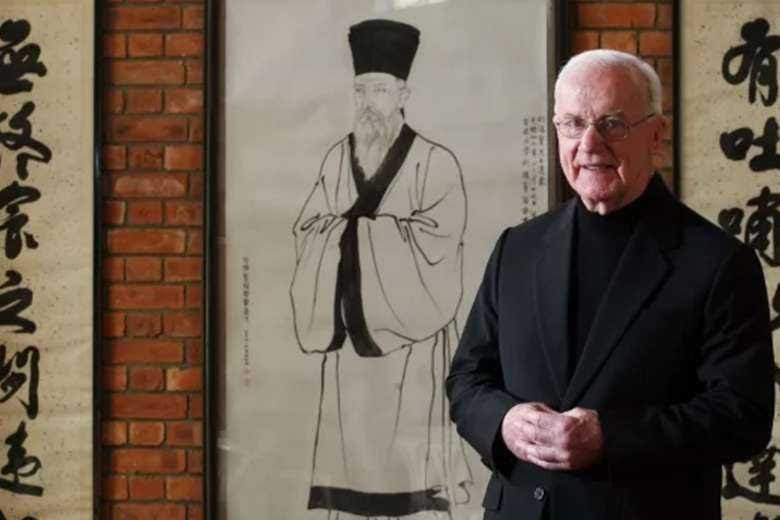
Jesuit Father Alfred Joseph Deignan served as a missionary in China for 65 years until his death in 2018. (Photo: Jesuits in Ireland)
A Jesuit think tank has constituted an award to honor prominent Irish Jesuit missionary Father Alfred Joseph Deignan that recognizes good business practices of small and medium enterprises (SMEs) in Macau and Hong Kong.
The Deignan Award for Responsible Entrepreneurship is a collaboration between the Macau-based Ricci Institut
Macau’s Portuguese-language Catholic weekly Jornal O-Clarim reported on April 22 that a committee comprised of an expert panel will choose enterprises based on compliance, corporate governance, social responsibility and business ethics.
“The prize obviously presupposes that the candidates must be diligent and act in accordance with public policies,” said Father Stephan Rothlin, director of the Ricci Institute.
A key point is the ability to demonstrate that ethics and law are elevated to the status of key factors in business practices and are implemented at all levels in the company, the Jesuit priest said.
Father Rothlin says the award celebrates the great missionary life of Father Deignan, who served as a missionary in China for about 65 years until his death in Hong Kong in 2018 at the age of 91. He was the superior of the Jesuit mission in Hong Kong from 1996 to 2002.
He was hailed for educating successive generations of students with a particular focus on values such as integrity, honesty, forgiveness and human dignity
The priest was a pioneer in education and humanitarian activities to tackle HIV/AIDS in the former British colony.
Born in Mullagh in County Cavan of Ireland in 1927, Alfred Deignan entered a Jesuit novitiate in 1945. He moved to Hong Kong at the age of 25 when he was a Jesuit scholastic.
“It was such a complete change,” he said of arriving in Hong Kong after 28 days on board the RMS Carthage, according to Jesuits in Ireland website. “Everything was strange. It was my first time out of the country.”
Deignan’s knowledge of the world outside Ireland was very limited, according to the Irish Times. He quickly made up for this by two years of full-time learning of Cantonese, followed by a year’s teaching at the Jesuit Wah Yan College in Hong Kong.
He went back home to finish his studies and returned to Hong Kong after his priestly ordination in Ireland in 1959. Hong Kong eventually became Father Deignan’s adopted home and he excelled there as an educator.
He served as principal of Wah Yan College and co-founded Hong Kong International Institute of Educational Leadership in 1997. He received honorary doctorates from the University of Hong Kong (2003), Hong Kong Institute of Education (2008) and the Chinese University of Hong Kong (2012).
He was hailed for educating successive generations of students with a particular focus on values such as integrity, honesty, forgiveness and human dignity.
Father Deignan also worked tirelessly to combat the rise of HIV/AIDS. He was a member of the Hong Kong Advisory Council on AIDS, member and vice-chairman of the Hong Kong AIDS Foundation, a member of the council of the AIDS Trust Fund, and chairman of an expert panel for HIV-infected healthcare workers. In 1993, he received the Governor’s Commendation for Community Service Award.
“I had the opportunity to work with Father Alfred Deignan over many years on different business ethics projects and I have always felt that the example of this deeply compassionate educator, with a huge passion for sharing the key values ??of integrity, compassion and honesty left a significant mark in various circles of society,” Father Rothlin said.
__________________________________________________________________
2.
The Beijing Seminary continues its synodal journey in the spirituality of Lent
12th April 2022
Agenzia Fides - www.fides.org
ASIA/CHINA - Prayer, relationship with Christ, new ways of
evangelizing:
Beijing (Agenzia Fides) - The life of prayer, the
consolidation of the relationship with Christ in order to help the faithful who are facing a crisis of faith, the new ways of evangelizing in the midst of a pandemic: these are some crucial points
that emerged during the monthly meeting of the Seminary Family of the Archdiocese of Beijing, which was held on March 24.
According to information gathered by Agenzia Fides, the intense synodal journey of
spirituality of Lent, preceded by a long meditation before the Blessed Sacrament and the Crucifix, marked the usual sharing of the seminarians, guided by the formators and the spiritual assistant.
Each class, group of seminarians and teaching staff presented their studies, their pastoral and missionary work carried out in the parish but also online, given that the pandemic situation does not
yet allow the normal development of the life of the Church. The seminarians also took part in the monthly community spiritual retreat, on the theme "Contemplation in prayer", on March 25 and 26. They
were invited "to always respond with the Fiat of the Virgin Mary to the Lord".
In addition, some seminarians are preparing, with great commitment and the support of
the entire seminary community, for the Beijing Civil Authority Higher Education Examination, which will take place from April 16 to 17, that is, on Easter Sunday. Along with prayer and encouragement,
the Seminary's Office of Academic Affairs provided them with the classroom and the necessary material for their studies, since cultivating knowledge is part of the integral formation of the Seminary,
in preparing candidates for the priesthood.
______________________________________________________________
3.
National Catholic Collection Day, an expression of the synodal journey in charity
5th April 2022
Agenzia Fides - www.fides.org
Rome (Agenzia Fides) - The pandemic has physically limited
the activities of Chinese Catholics, but has not been able to stop the generous heart of the Chinese Catholic community, which beats for the needs of all, Catholics and non-Catholics, Chinese and
non-Chinese, pushed moreover by the synodal journey of charity that it is carrying out together with the universal Church. For the sixth consecutive year, the Catholic community in mainland China
will celebrate next Sunday, April 10, Palm Sunday, the "National Day of collection in favor of the victims of natural disasters". According to information sent to Fides, until March 22, 2022,
therefore in the first 5 years, the initiative has collected ¥ 5,067,275.45, equivalent to € 745,187.5 and financed projects for ¥ 4,697,660.27, equivalent to €
690,832.35.
These include initiatives following floods and earthquakes
in various parts of China; after the Hualien earthquake in Taiwan, the volcanic eruption in Guatemala and the tsunami in Indonesia in 2018. Since the pandemic broke out until March 3, 2021,
Collection Day has collected more than 30 million yuan, equivalent to more than 4.5 million, to help pandemic areas in China and other affected countries by providing them with masks, machines,
protective equipment... In addition , maximum transparency and verification of the use of donations have characterized these years of commitment. Dioceses, parishes, congregations and religious
institutes, associations and ecclesial movements have always enthusiastically participated in the Palm Sunday collection.
One of the main promoters and organizers of the initiative
is Jinde Charites. The first non-profit organization established by the Catholic Church in China to provide social services, Jinde Charites has been guiding charities in the Catholic world in
mainland China and coordinating international donations for 25 years. According to information sent to Fides, the National Collection Day has always been welcomed with great goodwill by bishops,
priests and lay people, because they consider it an "opportunity to unite the whole Church, and together to witness faith and charity, promoting evangelization". At the same time, it constitutes a
concrete participation in the works of charity of the Chinese Catholic community, in the synodal journey of the universal Church, as Pope Francis wishes. "How I would like almsgiving to become a true
way of life for everyone! .... Each almsgiving is an opportunity to participate in the Providence of God towards his children" (Message of the Holy Father Francis for Lent
2018).
__________________________________________________________________
4.
A prayer app to help Chinese-speaking people “live Ignatian”.
24th March 2022
JCAP - Jesuit Conference of Asia Pacific
The app, which is still in its development phase but is already available to web users, is chock-full of prayer resources. The Prayer Corner inspired by Pray As You Go encourages people to develop the habit of daily contemplation. From Mondays through Fridays, users are invited to 15 minutes of guided contemplation based on the Gospel of the day. Then on Saturdays, there is a guided Examen, a prayer that helps one review one’s day, or in this case one’s week, in the presence of God. On Sundays, the app provides a recollection or longer form of prayer lasting about 45 minutes.
Another feature is Pilgrims on a Journey, where people from all walks of life share about their spiritual encounters and prayer life. Users can also take inspiration from Ignatius’ Thought for the Day, and listen to audio books or watch short videos on Ignatian Spirituality. Besides those, there are written meditations on the daily readings taken from Shalom and provided by the Hong Kong Christian Life Community, as well as homilies in a section aptly called, “The Plaza of the Word”.
The developers of the app hope that through this platform more Chinese-speaking people can grow deeper in their relationship with the Lord, and live a more meaningful life through the gift of Ignatian Spirituality.
Currently, the prayer app can be accessed through this link:
https://ignatius.appgyverapp.
and will be available on the App Store soon.
* The Jesuit Conference of Asia Pacific covers the life and service of the Society of Jesus in 16 countries in Asia and the Pacific.
__________________________________________________________________
5.
A synodal journey in charity: the "Volunteers of the Lord" at the forefront to fight the pandemic
31st March2022
Agenzia Fides - www.fides.org
Rome (Agenzia Fides) - Priests who guard the quarantined areas to enforce health rules at night, the nuns who
are drivers and messengers, the seminarians who load material aid, the laity who intervene in all areas where there are needs: these are the "Volunteers of the Lord" - as they have defined themselves
- who draw the current image of the Catholic Church in mainland China. To combat the pandemic, there is active coordination between the local Church, Catholic charities, parishes, governmental and
non-governmental organizations, in collaboration with civil authorities.
According to information gathered by Agenzia Fides,
Covid-19 is still circulating strongly in several Chinese regions.
The Catholic community, engaged for over two years in the
fight against the virus, has acquired some experience in coordinating and organizing material aid, but above all spiritual, moral and psychological support, which people today need more than ever,
both the population and doctors, volunteers and rescuers.
During a new Lent marked by the pandemic, the Catholic
community, with its many "Volunteers of the Lord", is carrying out a synodal journey of charity, based on prayer and fraternity. They thus build a "synodal Church" of communion, participation and
mission, as Pope Francis has recommended since the beginning of his Pontificate. On March 19, the seminarians of the diocesan seminary of Jilin, led by the rector, loaded, sorted and distributed
several trucks of aid, in the midst of the freezing cold, on the occasion of the feast of Saint Joseph, patron of the Seminary.
According to these young aspiring workers in the vineyard
of the Lord, "we lived an exceptional patronal feast, an experience of charity which makes us mature spiritually". They also donated ¥5,030 (equivalent to €760) from their savings, in addition to the
aid worth ¥114,455 raised with Jinde Charities. The Jilin community, under the coordination of Jinde Charities of Hebei, is mobilizing all parishes to raise funds and materials through parish wechat.
The home for the elderly, an isolated village and a popular neighborhood are the preferred recipients. Tangshan community priests have been carrying out night guards in the quarantined neighborhood
to impart "the spirit of serving Christ". The volunteer nuns climb the stairs thousands of times to bring food to quarantined citizens, and are happy, because "we serve Jesus". We are the image of
the Catholic Church". The communities of Jiangxi and Shaanxi also shine for the commitment of the "volunteers of the Lord" on the synodal path of charity. (NZ)
End
March Updates 2022
CATHOLIC CHURCH UPDATES
March 2022
6 Updates
1. Catholicism’s Overlooked Importance in Asia.
2. ASIA/HONG KONG -The laity, committed to being the engine of evangelization and participation in the synodal process.
3. The Bishops' Lenten recommendations to accompany the synodal journey of the communities.
4. Hong Kong bishop stresses dialogue in troubled region.
5. Chinese Catholic communities are living the new pastoral year intensely, in a synodal spirit.
6. Reconnect with family in the New Year, bishop urges young people.
1.
Catholicism’s Overlooked Importance in Asia
Catholicism – whether embraced or rejected – has played a crucial role in defining identity in Asia.
Many people believe that the Philippines is the most Catholic country of Asia. But this has not been the case since the 1990s; Timor-Leste now has a higher percentage of Catholics. How do we explain that this shift has attracted so little attention? What is this telling us about our geopolitical and modern biases? And why does it matter to get a better sense of Asian Catholicism?
The Philippines’ population is 83 percent Catholic today, compared to Timor-Leste and its 97 percent of Catholics. Casual observers might assume that the prevalence of Catholicism is due to Timor-Leste’s past as a Portuguese colony. But when Portugal left in November 1975, less than 20 percent of the Timorese population was Catholic. It was only during the brutal Indonesian colonization (1975-1999) that the Timorese became massively Catholic.
In other words, Catholicism in Timor-Leste is not merely a byproduct of Western colonization. It is something more recent and linked to inter-Asian dynamics. While the papal religion in Asia is dismissed as a cultural import at best, and often decried as a tool of Western colonization, such views ignore the many instances in which Catholicism stood as a shield of the oppressed. During the period of violent occupation and starvation, Catholicism helped to attract international attention to Timor-Leste. Once independence was secured, also helped favor reconciliation with the enemy: in this case, Indonesia.
Furthermore, the relatively recent conversion of Timorese people suggests that religious affiliation can shift quickly, even today. And this questions a modern truism which sees religion – and Catholicism in particular— as fixed, conservative, and declining.
To minimize this puzzling shift, people often respond that Timor-Leste is a small and peripheric island of Asia. We would point out that Timor-Leste is still a territory 20 times bigger than Singapore and located at the nexus of important geopolitical tensions, located between Australia and China. But even moving beyond Timor-Leste, Catholicism across the entire Asia-Pacific region deserves more attention than it receives.
Observers often claim that the papal religion is a tiny religious minority in the region. Setting aside the Philippines and Timor-Leste, Catholics represent less than 5 percent of the population in most Asian countries. Yet these national statistics hide the significance of Asian Catholicism at the local scale. For instance, while only 3 percent of the whole Indonesian population is Catholic, the island of Flores and parts of Papua are overwhelmingly Catholic. In these locales, Catholics are the majority; as a result, Indonesia’s national cohesion and territorial integrity depends on this “minority.”
Similarly, in countries like India, Sri Lanka, Vietnam, and Myanmar, Catholics are not evenly represented across the country. Some regions and cities can host a much stronger proportion of Catholics. Thus, Asian Catholicism cannot be understood just as a religious minority group. Its local footprint varies tremendously and impacts the construction of Asian nation-states.
Nonetheless, the importance of Asian Catholicism cannot be understood only through the numbers. For instance, when it comes to defining the most Catholic countries of the continent, scholars have argued that Japan and Thailand are essential to consider.
These two countries have long history of encounters with Catholicism. During the late 16th century, hundreds of thousands of Japanese people converted to Catholicism. This newly introduced faith acted as a tool to define the self-conception of the extremely diverse societies of the archipelago. Yet, in the face of this sudden fascination with a foreign religion, competing elites imposed an alternative path on Japan. During the Edo period (1600-1868), Japan’s rulers relentlessly worked at instigating a homogenous ethno-religious identity – in which Catholicism stood as a silent and invisible counter-model. In the making of modern Japan, Catholicism thus operated as a powerful imaginary Other, instrumental to constructing the unity of the modern state.
In Thailand, the encounter between local populations and Catholicism went through a different yet comparable path. The efforts to build a modern and homogenous Thai identity, the systemization of a Theravada ethos, and the divinization of the sovereign were in many ways inspired by and a response against the West and its archetypal religion, Catholicism. In Thailand and Japan yesterday, but also in India and China today, Catholicism operates as an existential question that cannot be easily dismissed, an often overlooked but powerful means of alternative identify formation.
Clearly, studying the significance of Catholicism in Asia cannot be limited to counting the number of believers. The influence of the papal religion is deeper and subtler than what quantitative statistics suggest. For many societies and ethnic groups of Asia who strive to define their collective identity and political model, Catholicism is a powerful player that generates a whole range of direct and indirect answers at local and national levels. Whether across the Japanese islands, around the Gulf of Thailand, in Central Asia, or throughout the Indian subcontinent, Catholicism may be perceived as an uncomfortable other, but it influences the ways modern governance, economic exchanges, and systems of knowledge and collective health are defined.
Indeed, education and medicine are two dimensions to carefully consider in any investigation of Asian Catholicism. Over the past centuries, Catholics have built countless educational and medical institutions across the many subregions of Asia. Those schools and hospitals play an important role in the local social fabric and in their assertion within global networks. In addition to the new knowledge and techniques they bring, these institutions spread alternative narratives and connect local populations to distant resources and partners. It is not surprising that elites and governments have often been monitoring closely Catholic schools and hospitals – if not taking them by force. Therefore, investigating the lived realities of Catholic social institutions spread across the many regions of Asia, as well as their occasional absence and disappearance, is a valuable way to understand local societies and politics, as well as the nation-states that encompass them.
Still, Asian Catholicism is not only about Asia. Numerous Catholics from Vietnam, the Philippines, and Sri Lanka have migrated to non-Asian countries in search of new opportunities. They contribute to the economy of their adopted countries and forge bonds of interconnection with Asia. Furthermore, Asian dioceses and religious orders do not hesitate to send clergy members –seminarian, priests, and nuns— to study and serve in non-Asian countries. In Europe, Indian and Vietnamese priests constitute a growing part of the local clergy. Despite the little attention they receive, they allow European Catholicism to maintain some of its operations and to reimagine itself.
Present all around the globe, Asian Catholics are a vibrant component of the global networks that shape our contemporary world. In North America, they sustain numerous ethnic parishes and influence the way American Catholicism positions itself in regard to world affairs and the Sino-American competition. In Dubai, it is Filipino, Malayali, and Konkani churchgoers who represent the largest Catholic communities. Together, they show how the number of Catholics in the Middle East is not simply declining but in the midst of intense reconfiguration.
Finally, with a growing number of Asian Catholics accessing high responsibilities within the Catholic hierarchy, their specific concerns and sensibilities are most likely to reshape the priorities of the Catholic Church. Simultaneously, the increasing importance of the Asia-Pacific region is going to give more weight to their voices even though Asian Catholics are still numerically fewer than African and Latino Catholics. Thus, either within or outside the Church, Asian Catholics are an important force to consider.
In conclusion, there is an urgent need to overcome modern prejudices and carefully scrutinize the ways in which the world’s most populous continent – Asia – and the world’s largest religious organization – the Catholic Church – intersect. While Catholicism is neither on the decline nor limited to religious affairs, a social scientific study of Asian Catholicism will provide a unique window not only on how Asian societies and the Catholic Church evolve, but also on how they influence each other and shape global affairs. Investigating Asian Catholicism will not only question prevailing discourses on colonialism, national identity, and globalization but provide an analytical tool less pliable to economic ideologies and national interests.
Asian Catholics stand at the nexus of most pressing geopolitical questions. While other religions of Asia have been the object of intense scholarly scrutiny, it is now time to recognize the global significance of Asian Catholicism.
____________________________________________________________________________
2.
ASIA/HONG KONG- The laity, committed to being the engine of evangelization and participation in the synodal process.
16th March 2022
Hong Kong (Agenzia
Fides) - The Association of Catholic Laity of the Diocese of Hong Kong (Hong Kong Central Council of Catholic Laity HKCCCL) has renewed its commitment to being the engine of evangelization in the
diocese on the way to the Synod of Bishops in 2023.
During the Annual
General Assembly, which was held online as Hong Kong is still in the grip of a pandemic, the inauguration of the new President of the Association, Ms. Jojo, also took place in the presence of Msgr.
Stephen Chow Sau Yan, SJ, Bishop of Hong Kong. According to Kung Kao Po, the weekly newsletter of the diocese, Bishop Chow encouraged the lay faithful to practice the mission of evangelization, to
empty themselves, to bring hope and reconciliation to others, to reach out to the excluded society to help them, especially during the Covid epidemic.
Fr. Joseph Liu Ahlun,
spiritual director of the Association, highlighted the work carried out during the pandemic, with a thousand difficulties, always cultivating and promoting the cause of evangelization, starting with
the formation of the laity. In view of the Synod of Bishops to be held in October 2023, the Association has coordinated consultations between parishes and lay groups, distributing the questionnaire
and proposing a series of conference themes, in order to allow the active participation of lay faithful, protagonists of evangelization, in the synodal process. The pandemic has impeded face-to-face
evangelism, but the Association has creatively launched WhatsApp, Signal, electronic prayer messages, etc., continuing the mission of announcing the Gospel, showing closeness and blessing of the
Church to all, without ever neglecting concrete works of charity.
The Catholic Lay
Association of the Diocese of Hong Kong, the central body for evangelization in the diocese, is made up of representatives of the various parish councils, pastoral councils and Catholic associations.
It has 81 affiliated associations, including 51 councils and 30 Catholic associations.
_______________________________________________________________
3.
The Bishops' Lenten recommendations to accompany the synodal journey of the communities
9th March 2022
Agenzia Fides - www.fides.org
CHINA - Spirituality, concrete abstinence, conversion, pandemic: the Bishops' Lenten
recommendations to accompany the synodal journey of the communities
Beijing (Agenzia
Fides) - "I sincerely hope that the reading of the Word of God, the recitation of the Rosary and the Way of the Cross will be more and more widespread in families and communities", recommended in his
Pastoral Letter for Lent , Msgr. Joseph Li Shan, Archbishop of Beijing. He also asked the faithful for an abstinence that is not only formal, but linked to concrete life, that is to say "abstinence
from speech, eyes, ears, internet, bad temper and negative temperament".
In his pastoral
letter titled "Living Lent with Prayer, Fasting and Charity", Bishop Li reminds the faithful that Lent is the time to "renew our relationship with God, with ourselves and with others". As the world
tries to overcome the severe crisis of the pandemic and its negative consequences, "we need even more the power of faith". He therefore encourages all families to pray together, because "the family
that prays together, stays together" as the Holy Father Francis teaches us in "Amoris laetitia". He then invited people to get used to "reading one or two verses of the Gospel every day", to "always
have the Bible in our hands, in our pockets, on our mobile phones".
As far as abstinence
is concerned, "canonical abstinence" or "diet" is not enough to keep fit, but it must mean "leaving more space in our hearts, letting ourselves be filled by grace and the strength of Christ, in order
to control our egocentrism, to avoid sins and to practice charity". And "this charity, starting from the family, extends to the neighbour, to the community and to society", thus continuing the
synodal path with the universal Church. Finally, Bishop Li also underlined the commitment in this liturgical time to "accompany catechumens to live a life of holiness, incarnating the image of Jesus
Christ", only in this way "our joy will be complete" (Cf. Jn 16, 24 ).
As every year,
several Chinese diocesan bishops have shown their faithful the Lenten journey, drawing inspiration from the message of Pope Francis for this liturgical season, in the spirit of the synodal journey
that the whole Church lives. "Let us not grow tired of doing good, for in due time we shall reap our harvest if we do not give up. So then, while we have the opportunity, let us do good to all" (Gal
6: 9-10a), writes the Holy Father.
The Archbishop of
Guangzhou, Msgr. Joseph Gan Junqiu, urged the faithful to "reconcile with the Lord", as he wrote in his Lenten pastoral letter entitled "Produce therefore fruits worthy of conversion" (Mt 3: 8). The
new Bishop of Hong Kong, Jesuit Bishop Stephen Chow Sau Yan, shared his deep concern over the pandemic situation on the island with a father's heart in a message titled: "Blessings Under the Pandemic
- Loving Beyond Ourselves Through Adversity".
He exhorted everyone
to "raise our small self to the big self, which is the common good", which "embraces the elderly, the sick, the weak and the poor ...". With this in mind, he wrote: "We do not know when this pandemic
will be over. Nevertheless, we can do our best to do good and introduce the love of God to more sectors in Hong Kong, especially those who are neglected or vulnerable… Let us not underestimate the
power of prayers. And let us not lose hope in the efforts of the Holy Spirit through us".
_______________________________________________________________
4.
Hong Kong bishop stresses dialogue in troubled region
24th February 2022
UCA News - www.ucanews.com
Bishop Stephen Chow feels dialogue and working with government are crucial to playing the
prophetic role as Christians
By: Gianni
Criveller
Jesuit Father Stephen
Chow Sau-yan was consecrated bishop of Hong Kong last December after the seat was vacant for nearly three years. It ushered in a ray of hope among Catholics in the Special Administrative Region of
China facing political uncertainties and chaos.
During his
consecration, the new leader of some 400,000 Catholics in Hong Kong promised to heal the wounds of the deeply polarized city by building bridges.
He has reiterated his
priorities as the leader of the Church in Hong Kong in an interview he gave me — the first and most elaborate interview he has given to the media since becoming a bishop. It first appeared in the
February issue of the Milan-based Mondo e Missione (World and Mission), a magazine run by the Pontifical Institute for Foreign Missions (PIME).
Bishop Chow is aware
of the socio-political relevance of Hong Kong’s Catholic community despite its numeric size. In fact, several of Hong Kong's leaders on both sides of its political spectrum — pro-government and
pro-democracy camps — are either Catholics or have a close association with Catholic institutions such as schools, parishes and organizations.
For example, Hong
Kong’s pro-Beijing Chief Executive Carrie Lam is a practicing Catholic who attended the bishop’s consecration ceremony. On the other hand, prominent democracy champions in the city include Catholics
Martin Lee, Jimmy Lai and many others who have been jailed since Beijing imposed the national security law on July 1, 2020.
As the Hong Kong
Church leader, Bishop Chow needs to tread a fine line in the fractured city. Under the circumstances, his reluctance to give press interviews is understandable. But he agreed to speak with me as a
brother in faith in the same mission of evangelization.
My aim was never to
corner him with tricky questions but to help the global Catholic communities to see his situation and understand his priorities as he works to heal the wounds and build bridges among communities in
Hong Kong.
His Jesuit upbringing
and training, Bishop Chow said, encourage him to work for human dignity and social justice. “I find it unacceptable when basic human dignity is ignored or exploited or sidelined,” he
said.
He said a bishop is
not a diplomat but needs to be diplomatic at times to carry out God’s will. “I’m not a diplomat; a bishop is not a diplomat. We need to be diplomatic at times. But our primary concern is to discern
God’s will and to carry it out.”
He remembered Jesuit
Father Alfred Deignan as his mentor who taught him compassion, patience and hope, and Father James Hurley as one who inspired him to engage in human rights
work.
Bishop Chow said the
Tiananmen Square tragedy of 1989 profoundly affected him and he joined rights group Amnesty International around that time. He is no longer an Amnesty
member.
“The incident in 1989
really affected me. It put me in touch with my ethnic identity, with who I am; my plight and the plight of the Chinese people were connected through that incident,” he
said.
His reference to
Jesuits Fathers Deignan and Hurley shows how Catholicism was shaped in Hong Kong over the past 50 years. Father Deignan (1927-2018) was a widely influential and appreciated educator who served in
Hong Kong for 65 years. Father Hurley (1926-2020), who championed social justice, was a missionary in Hong Kong since 1952.
Bishop Chow’s
explicit mention of the Tiananmen incident as a turning point of life is also remarkable. Sadly, the Hong Kong administration since 2020 has banned the annual vigil and commemoration for the
Tiananmen anniversary at Hong Kong’s Victoria Park.
Bishop Chow says
Ignatian spirituality has “a great impact” on him “on how I see God, my relationship with him and God’s relationship with the world. We are sinners, yet loved. That gives us hope! That inner freedom
lets us move on. No one is totally indifferent with inner freedom, neither am I.”
He said he accepted
the role of the bishop as part of “a process of seeking inner freedom. I didn’t really want to [be a bishop]. But in this process, I was invited to obedience; meaning to let
go.”
“Ignatian
spirituality broadens my thinking. If spirituality is not incarnated, it remains in the air. It has to connect to who I am.”
Bishop Chow’s
education at Harvard University taught him how cultures impact the lives of humans more than they can realize.
A Harvard professor
taught him the meaning of culture “and how it impacts us. Culture affects us more than we are aware of. Culture is very subversive. We educators are co-constructors with the young people we
serve.”
Bishop Chow wants to
engage with young people through dialogue as they are “more receptive than adults or older because they are more willing to try out things and can see a future of possibilities; they have less
baggage, so to speak.”
He would often ask
young people to be like a giraffe “with feet planted on the ground and a vision looking to the future. We cannot always have all our feet on the ground at one time; when the giraffe moves, one foot
is in the air, so we need vision. We have to keep vision and context together.”
Young people, mostly
university students, were spearheading the pro-democracy movement in Hong Kong. But Bishop Chow wanted young people “not to look at the walls only but to look at the future: how you want Hong Kong to
be like in future.”
“Share your vision
with your peers … but at the same time, don’t limit yourself to listening to like-minded people, otherwise you will share the same blind spots. You need to listen to people who are very different
from you, who even don't agree with you.”
The Hong Kong bishop
says he won’t leave elderly people behind.
“The young can help
the older members of the community. The young are the ones who give hope and energy to the elderly. Since 2019 some elderly felt that the young people were insensitive — and some of them were. The
two groups can come together and talk, share and help each other,” he said.
Bishop Chow said the
introduction of national security law marked a new era in the political history of Hong Kong.
“We have to be
careful; we don’t want to get our children, our students or the school into trouble. We have to protect our students. As educators, we still hope that our students can think for themselves and have
multiple perspectives and appreciate differences,” he said.
Elders should help
younger generations know “what is legal and what is not legal” and at the same time “to help them think.” The younger generation should develop a healthy conscience despite ideological differences —
whether rigid conservative or neurotically liberal, he said.
He said he wanted to
help “our young people think deeper in this age. But it is a difficult task. Veteran teachers have emigrated. Even social workers and psychologists have moved away. This is the difficult reality we
have to face.”
Despite the difficult
circumstances, Bishop Chow is hopeful about the future of missionary presence in Hong Kong.
“I really believe
that foreign missionaries have a place in Hong Kong. We appreciate what they have done and we do our best to keep them here. Hong Kong has to remain an international city, with missionaries and
expatriates.”
Bishop Chow believes
it is essential to have dialogue and work with the government to play the prophetic role as Christians.
“We have to work with
the government and find whatever space we can. But, in humility and a spirit of dialogue, we can still say what we think, as we are here as prophets.”
* Father Gianni Criveller of the Pontifical Institute for Foreign Missions is dean of studies and a
teacher at PIME International Missionary School of Theology in Milan, Italy. He taught in Greater China for 27 years and is a lecturer in mission theology and the history of Christianity in China at
the Holy Spirit Seminary College of Philosophy and Theology in Hong Kong.
_______________________________________________________________
5.
ASIA/CHINA - Chinese Catholic communities are living the new pastoral year intensely, in a synodal spirit.
21st February 2022
Agenzia Fides - www.fides.org
Rome (Agenzia Fides)
- " The "Year of God", which was celebrated in 2021, will be followed in the Archdiocese of Beijing by the "Year of the Son of God" announced by Archbishop Joseph Li Shan in his Christmas message.
The various parishes of the Archdiocese now have their own pastoral programs in this context created, which are now being put into practice.
Meanwhile, the parish
of the Immaculate Conception, known as "Nan Tang" congregation, invites you to a year of Bible reading. Believers are encouraged to meditate on the life of Jesus based on the reading to draw closer
to his cross and make him more visible in their daily lives. From February 2nd, the Feast of the Presentation of the Lord in the Temple, until February 17th, each parishioner read a chapter from the
Gospel of Mark.
In addition, the
basic church communities in the parish organized themselves for the annual joint reading. Throughout the year, the members of each community read and study the Gospel together, then share it with the
other communities to grow together in faith and love for the Lord and neighbor, in the spirit of the synodal journey.
In the parishes of
Jiangxi province, meanwhile, parish priests distributed a copy of the Bible to the faithful during the solemn celebration of the Eucharist in thanksgiving for the Chinese New Year, thus opening the
"Year of the Word of God". It was a gesture to recall the importance of the Word of God in Christian life and in everyday life, and to make Scripture concrete and relevant in the lives of individuals
and communities.
On the occasion of
the 164th anniversary of the apparition of Our Lady of Lourdes, the community of Shantou in Guangdong province has started a "Year of the Rosary". From February 11, 2022 to February 11, 2023, the
faithful will recite a rosary daily, individually or together, with different intentions: peace in the world, the end of the pandemic, the unity of the Church, the growth of vocations and, above all,
the consolidation of the life of faith.
_______________________________________________________________
6.
Reconnect with family in the New Year, bishop urges young people.
11th February 2022
Sunday Examiner - Hong Kong
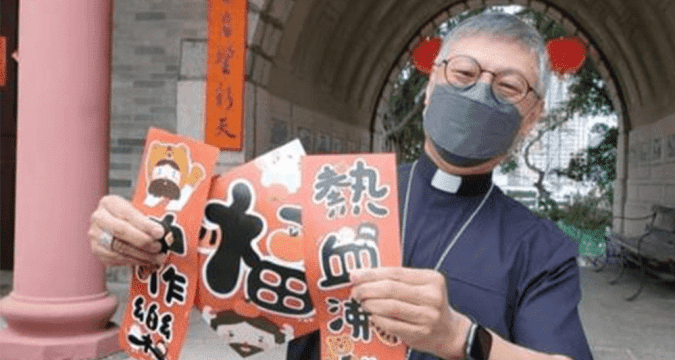
HONG KONG (SE): Bishop Stephen Chow Sau Yan, SJ, in a video message for young people at the start of the Year of the Tiger, encouraged them to strengthen their relationship with their families even though there might be problems between them. He also urged them not to lose their passion and face life with the zeal of a tiger.
The video message was posted on Boiling Point, the youth Facebook forum supported by the Diocesan Audio Visual Centre and the Diocesan Youth Commission, on February 1, the first day of the Lunar New Year.
The bishop said that he understood the frustration of having to stay at home as Hong Kong entered the fifth wave of the Covid-19 pandemic, with community celebrations of the liturgy and in-person classes in schools suspended again. He said he could also see that in this situation, young people tend to stay at home with their families more often and encounter more conflicts in Hong Kong’s small flats.
However, he expressed his hope that young people will not be depressed. “It will pass,” he said.
“It is New Year. We all hope for a good beginning for you and your family members. Blood is thicker than water. Your relationship lasts for a lifetime. Do not let obstacles and problems, though they are serious ones in your mind, occupy the whole family life,” he exhorted.
‘“Things around us may fall short of our expectations. However, it is important to change our minds with kindness and love, and do small acts of love for family and friends’
“There are many things for the family to talk about and many beautiful memories to share. We can build a good future together. So have confidence,” he continued.
Bishop Chow explained that many external factors affect our mood, like the cold and wet weather, which makes it hard to go out and makes us feel gloomy and dispirited. He encouraged young people not to be affected by the outside environment and instead remain joyful.
“Things around us may fall short of our expectations. However, it is important to change our minds with kindness and love, and do small acts of love for family and friends. For example, send a message or make a phone call, which I think is good as people can hear your voice,” he said, adding that many people, especially the elderly, who may feel lonely, need to be reconnected with others.
“Let us take the opportunity in the Chinese New Year to rebuild and strengthen our relationship with others so that we can face things with positivity in the coming year,” the bishop said.
Concluding his message, Bishop Chow exhorted young people to be vigorous and cheerful in adversity like a tough tiger. “The zeal of young people in faith, in life and for their future should never be cooled down,” he said.
The bishop noted that in ancient Chinese tradition, the tiger is a spiritual animal that protects people. “In the future, many people will need your protection and your blessings,” he said.
End
February Updates 2022
CATHOLIC CHURCH UPDATES
February 2022
4 Updates
1. Chinese New Year and sharing God’s love.
2. Year of the Tiger: Christ the tiger?
3.China’s Catholic institute marks 20 years of study of Christianity.
4. CHINA - Towards Lepers' Day: the Catholic community in action, like all year round.
1.
Chinese New Year and sharing God’s love.
28th January 2022
Sunday Examiner - Hong
Kong
http://www.examiner.org.hk/
Editorial
Traditionally, Chinese families clear out their junk and clean their homes three days before the Chinese New Year. This custom means sending away the old and welcoming the new;
hoping to prepare for the new year with the cleanest and best outlook, which is understandable. We Catholics are not only concerned about the cleanliness and tidiness of the external environment, but
also concerned about spiritual sanctity. Let us take this opportunity to clear out the long accumulated dirt, bad habits and ill thoughts.
The cleansing our hearts can be done through retreats, self-discipline and devotion to God’s Word. We get rid of our negative emotions, lay down resentment and stubbornness and
learn to forgive.
Peter asks Jesus whether it is enough to forgive those who sin against him up to seven times. Jesus answers him: seventy-seven times [Matthew 18:21]. This is not to be understood
literally. Jesus uses this metaphor to encourage us to follow God’s immense kindness and practice the virtue of forgiveness. God does not set a limit to forgiveness. As long as we repent sincerely
and promise that we will not sin again, we are forgiven.
Besides reconciling with God and other people, we should seek to rebuild our relationship with nature. Massive tree felling, mechanical over-production and development, and land
reclamation not only destroy the ecological balance, but also cause all sorts of pollution.
Ultimately it is human beings who suffer. Pope Francis promulgated the encyclical, Laudato Si’, in 2015 to encourage people to embrace ecological conversion, concern for our shared
habitat and repentance for ecological destruction. Certain religious congregations have promoted land ‘rebirth’ to rebuild the ecological system through field farming and to experience the wonder of
nature.
As the Lunar New Year approaches, think about sharing your happiness and grace with the disadvantaged. Some members of some parish social concern groups regularly visit the
homeless. They provide warmth in the cold winter by distributing hot food and warm clothes. The homeless can experience the compassion of society through heartfelt greetings and loving
care.
Some communities and the young people have designed various cards to express new year greetings. They also created virtual stickers, emojis and wallpapers for the faithful to
download onto their smartphones to use on social media such as WhatsApp, Signal and Instagram. They are especially encouraged to bestow God’s blessings on non-Christians with these tools, so that
they may share the gospel.
Although we cannot physically participate in Masses and parish meetings at this time, we can break through geographical restrictions by attending online Masses. The daily scripture
readings also draw us closer to God. SE.
_______________________________________________________________
2.
Year of the Tiger: Christ the tiger?
JCAP - Jesuit Conference of Asia Pacific
https://jcapsj.org/

The Chinese New Year, also known as the Lunar New Year or Spring Festival, begins on 1 February. It is usually celebrated for 16 days, from Chinese New Year’s Eve to the Lantern Festival. According to Chinese zodiac, 2022 is the Year of the Tiger. Fr Francis Lim SJ reflects on the symbolism of the tiger, and how it has been used by some authors to signify Christ.
Tigers are considered the most iconic of the big cats. Tigers, being the largest felines in the world, are considered by many cultures to be a symbol of strength, courage, independence, and majestic dignity.
The tiger is careful, crafty and suspicious in a good way. It is careful to avoid pitfalls and traps. It is rarely taken by surprise. Following the example of the tiger, we must stay alert, we must walk carefully, and we must be wise in the Lord.
There are two subspecies of tiger, commonly referred to as the continental tiger, and the Sunda island tiger. All remaining island tigers are found only in the island of Sumatra. The continental tigers are found in the mainland of Asia, stretching from India to Siberia, and south to the Malay peninsular. The largest tiger is the Siberian or Amur, while the smallest tiger is the Sumatran.
No two tigers have the same stripes, and their stripes are as individual as fingerprints are for human beings. A tiger’s stripes are important for survival in the wild as they act as camouflage which appear as moving shadows in long grass and in trees. Therefore, the stripes of the tiger are what make the tiger majestic and unique.
In the Bible, lions and leopards are mentioned but no tigers. Furthermore, interestingly there is not one mention of a domestic cat.
It is because tigers are not native to the Middle East. We can assume that none of the Hebrew speaking, Aramaic speaking, or Greek speaking authors ever saw or heard of a tiger.
The closest to the tiger in the Bible would be the lion which also symbolises authority and royalty. On top of that, some older English translations of the Bible mistakenly translated lion as tiger in some texts.
Interestingly, there is an autobiography called “Christ the Tiger” by Thomas Howard published in 1967. Howard was born evangelical in 1935, but converted to Catholicism in 1985.
“Christ the Tiger” was written before Howard became Catholic. It is not an exposition about Christ, but rather an autobiography of a sharp and restless mind. The book should have been named “Tom the Tiger”; although this title would not have sold the book!
In his book, Howard spends a long time unveiling the unmanageable thoughts of a young man who has been caught up by the love of Christ rather than portraying Christ himself. Initially he saw dogmas and institutions as obscuring the powerful truth of God’s love in Christ. He argues that Jesus is always greater than any theology. However, Howard demonstrates his awareness that without those institutions there would not be any way of encountering Christ the tiger. This book radically presents who Christ is and what faith in him means.
Howard was greatly influenced by the famous writer, CS Lewis, who was in turn influenced by another great writer, GK Chesterton. Howard did his doctoral dissertation on the writings of Charles Williams who was a good friend of Lewis. Howard is generally considered an expert on the writings of Williams.
Lewis and Williams compared Christ to a lion, but Chesterton and Howard compared him to a tiger. Chesterton says that when you make the claim that God is a reality like a tiger, which is a reason for changing your life, the modern world will try to stop you if it can. Then, be prepared to be opposed. Prior to that, TS Elliot, a poet, had also used the image of Christ as a tiger in his poem, “Gerontion.”
Nonetheless, whether it is a tiger or a lion to signify Christ, the idea is to manifest Christ as majestic, courageous and authoritative. We, who are the disciples of Christ, can imitate him in this way, too. Happy Lunar New Year!
Fr Francis Lim Chin Choy SJ is the Communications Officer of the Malaysia-Singapore (MAS) Jesuit Region. To celebrate the Lunar New Year, MAS Communications prepared eight IHS logos with Chinese designs. They are available to download for free as .png files, WhatsApp stickers, and Viber stickers.
Copyright © 2022 Jesuit Conference
of Asia Pacific, All rights reserved.
The Jesuit Conference of Asia Pacific covers the life and service of the Society of Jesus in 16 countries in Asia and the Pacific.
___________________________________________________________________
3.
China’s Catholic institute marks 20 years of study of Christianity.
25th January 2022
UCA News - www.ucanews.com
Institute for Study of
Christianity and Culture promotes dialogue between the inculturation of faith and the evangelization of cultures
UCA News reporter
A Catholic-run institute in Chinese capital Beijing has marked 20 years of academic research on Christianity and culture and the promotion of evangelization in China and
beyond.
The Institute for Study of Christianity and Culture under the Archdiocese of Beijing was founded in 2002 by Father Peter Zhao Jianmin, vicar of the Archdiocese of Beijing, who
graduated in canon law from the Catholic University of Leuven in Belgium.
Father Zhao is the first Chinese priest to obtain a doctorate degree after the opening up of the Church in China 1970s following the communist takeover, brutal Cultural Revolution
and China’s severance of diplomatic ties with the Vatican.
Since its foundation, the academy has sought to study religions, especially Christianity, local culture and promote greater harmony between Catholicism and traditional Chinese
culture, according to Fides new agency.
It has promoted the study of various themes through debates, conferences, publications, seminars, forums, training courses, scholarships and international exchanges, with topics
ranging from Mariology and St. Ambrose to the doctors and fathers of the Church, the contributions of Chinese and foreign missionaries to evangelization and social development in
China.
The institute has been a pioneer in mainland China for paving the way for dialogue between the inculturation of faith and the evangelization of
cultures.
In an interview with UCA News in 2006, Father Zhao said it was essential to have academic dialogue between the China Church and theologians on the world scene. For that purpose, it
was vital for the Church to promote scholarship by adopting positive and substantial policies to support theological research.
The institute's director said the China Church needed to learn more about the conceptual development of Catholic theology, which links the local Church to the teaching of the
universal Church.
He suggested the need for “more research on inculturation so the Gospel could be spread throughout Chinese civilization.”
Since 2003, the institute has conducted training courses and seminars for young people on the theme of “Catholicism and Ethics” and published the texts in its Journal of Catholic
Studies.
Another major program of the institute is an annual Forum on Catholic Studies for Young Chinese Scholars that began in 2008.
The institute also collaborates with Chinese and international partners including the Social Academy of Beijing and the Catholic University of
Leuven.
In 2019, during the XXIV Public Session of the Pontifical Academies, Pope Francis reportedly praised the academy for its role, especially on evangelization, over the
years.
"The academy ... is also a force of evangelization, which belongs to the present of the Church and her mission," the pope said.
The earliest documented presence of Christianity in China is seen in Nestorian missioners who came to the then Chinese capital of Chang’an (Xi’an) during the rule of the Tang
dynasty in 635 AD.
The first Catholic mission to China was led by Franciscan friar Giovanni da Montecorvino, who arrived in what is now Beijing in 1293. Russian Orthodoxy was introduced in 1715 and
Protestants started their mission in China in 1807.
A nationwide survey by the Chinese Academy of Social Sciences in 2010 showed that China's 23 million Protestants accounted for 1.8 percent of its 1.3 billion
people.
Officially, mainland China has 6 million Catholics. The Holy Spirit Study Centre of Hong Kong Diocese estimates that China has some 12 million Catholics, including “unregistered”
Catholics who reject the government-sanctioned Chinese Patriotic Catholic Association.
_______________________________________________________________
4.
CHINA - Towards Lepers' Day: the Catholic community in action, like all year round.
14th January 2022
Agenzia Fides - www.fides.org
CHINA - Towards Lepers' Day:
the Catholic community in action, like all year round
Nanjing (Agenzia Fides) - Like every year, members of the Nanjing Ark Charity Foundation, the charitable foundation of the Catholic community in Nanjing, capital of Jiangsu province
- one of the many Catholic charities scattered throughout mainland China - provided aid, gifts and good wishes for the Chinese New Year to cured lepers, guests of the Nanjing Public Health Medical
Center.
The 69th World Leprosy Day and the 30th Chinese Leprosy Day will be held on Jan. 30, the former under the theme "Forgotten diseases still exist. Help us to erase them forever",
while the theme of the Chinese Day is "Caring for lepers, building a better life together". With this visit, the volunteers maintained the Catholic tradition of caring for lepers and people in need
in the Nanjing community, which now dates back to the year 2000.
However, this is a year-round commitment and has never been limited to Leper Day. Indeed, the volunteers of the foundation periodically visit lepers and healers, offering them not
only the material goods they need, but also spiritual and moral comfort, listening to them, breaking their loneliness, sharing their worries.
In 2015, during the celebration of the 10th anniversary of the Ark-Nanjing Special Education Center in the Cathedral of the Archdiocese of Nanjing dedicated to the Immaculate
Conception, the Nanjing Ark Charitable Foundation was officially born and has been operating for years with the approval of Nanjing Municipal Civil Affairs
Bureau.
The new foundation has faithfully followed the mission of helping the disadvantaged in society: the elderly and orphans, the poor, the physically and mentally disabled, the victims
of natural disasters, poor children who are offered the opportunity to study, and above all the girls and children of immigrant working parents, who are the most disadvantaged. They also manage the
canteen, the laundry, the showers, vocational training to give them a chance to reintegrate into society ...
Throughout the history of assistance to lepers in China, the Chinese Catholic Church has always been at the forefront, as documented by Agenzia Fides, which illustrated, among other
things, the commitment of the nuns who manage the center for lepers in Yunnan. Sister Xue Ling, of the Diocesan Congregation of the Holy Family in Lanzhou, Gansu Province, died in a flood on June 13,
2008 while helping lepers. For years, her Congregation has been assisting leprosy patients in the district of Huiyang, in the province of Guangdong (see Fides, 16/6/2008). Since 2009, the Chinese
sisters led by Jinde Charity (China's largest Catholic charity organization) have started participating in the Beijing Marathon to raise funds for Catholic Church projects for the elderly, orphans,
for the prevention of AIDS and also for lepers (see Fides, 24/10/2013). (NZ)
End
 Print
Print 